Ch. 34 - The Wave Nature of Light: Interference and Polarization
Giancoli Douglas - Physics for Scientists and Engineers 5th edition
Giancoli Douglas5th editionPhysics for Scientists and EngineersISBN: 9780137488179Non è quello che usi tu?Cambia libro di testo
Capitolo 33, Problema 34

A uniform thin film of alcohol (n = 1.36) lies on a flat glass plate (n = 1.56). When monochromatic light, whose wavelength can be changed, is incident normally, the reflected light is a minimum for λ = 492 nm and a maximum for λ = 615 nm. What is the minimum thickness of the film?

Guida verificata passo dopo passo
1
Step 1: Understand the problem. The thin film interference occurs due to the constructive and destructive interference of light reflected from the top and bottom surfaces of the film. The problem provides the refractive indices of alcohol (n = 1.36) and glass (n = 1.56), and the wavelengths of light corresponding to minimum (λ_min = 492 nm) and maximum (λ_max = 615 nm) reflected intensity. We need to find the minimum thickness of the film.
Step 2: Recall the condition for destructive interference (minimum reflected light). For normal incidence, the path difference between the two reflected rays is 2t, where t is the thickness of the film. The condition for destructive interference is: 2t = (m + 0.5) * λ/n, where m is an integer, λ is the wavelength in vacuum, and n is the refractive index of the film.
Step 3: Recall the condition for constructive interference (maximum reflected light). Similarly, the condition for constructive interference is: 2t = m * λ/n, where m is an integer, λ is the wavelength in vacuum, and n is the refractive index of the film.
Step 4: Use the given wavelengths to establish a relationship between the two interference conditions. For λ_min = 492 nm (destructive interference) and λ_max = 615 nm (constructive interference), the difference between the two conditions corresponds to a change in the integer m. Specifically, the difference in path length is one full wavelength in the film: (λ_max/n) - (λ_min/n) = λ_film, where λ_film is the wavelength of light in the film.
Step 5: Solve for the thickness t using the constructive interference condition for λ_max. Rearrange the formula: t = m * λ_max / (2 * n). Use the relationship established in Step 4 to determine the appropriate value of m and calculate the minimum thickness of the film.

Concetti chiave

Ecco i concetti essenziali che devi comprendere per rispondere correttamente alla domanda.

Thin Film Interference

Thin film interference occurs when light waves reflect off the boundaries of a thin film, such as the alcohol layer in this question. The interference pattern results from the superposition of light waves reflected from the top and bottom surfaces of the film, leading to constructive or destructive interference depending on the film's thickness and the wavelength of light.
Video consigliato:
Percorso guidato
03:47
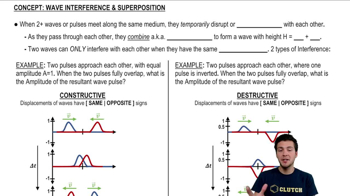
Wave Interference & Superposition

Wavelength and Refractive Index

The refractive index (n) of a material affects how light travels through it, altering its speed and wavelength. In this scenario, the refractive indices of alcohol and glass influence the conditions for interference. The relationship between wavelength in a vacuum and in a medium is given by λ_medium = λ_vacuum / n, which is crucial for determining the effective wavelengths for interference.
Video consigliato:
Percorso guidato
03:46
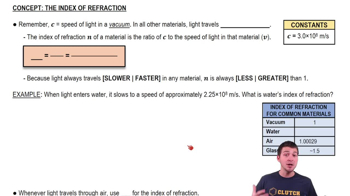
Index of Refraction

Condition for Minima and Maxima

For thin films, the conditions for minima and maxima in reflected light depend on the film's thickness (t) and the wavelengths of light. A minimum occurs when the path difference between the two reflected waves is an odd multiple of half the wavelength, while a maximum occurs at an integer multiple of the wavelength. These conditions help calculate the film's thickness based on the observed wavelengths.
Video consigliato:
Percorso guidato
05:55
LRC Circuits in Series
Pratica correlata
Domanda del libro di testo

A single optical coating reduces reflection to zero for λ = 550 nm. By what factor is the intensity reduced by the coating for λ = 430 nm and λ = 670 nm as compared to no coating? Assume normal incidence.

132
views

Domanda del libro di testo

Show that the radius r of the mᵗʰ dark Newton’s ring, as viewed from directly above (Fig. 34–18), is given by r = √mλR where R is the radius of curvature of the curved glass surface and λ is the wavelength of light used. Assume that the thickness of the air gap is much less than R at all points and that r ≪ R . [Hint: Use the binomial expansion.]

125
views
Domanda del libro di testo

(I) If a soap bubble is 120 nm thick, what wavelength is most strongly reflected at the center of the outer surface when illuminated normally by white light? Assume that n = 1.35.

45
views
Domanda del libro di testo

(II) When a Newton’s ring apparatus (Fig. 34–18) is immersed in a liquid, the diameter of the tenth dark ring decreases from 2.92 cm to 2.54 cm. What is the refractive index of the liquid? [Hint: See Problem 37.]

62
views
Domanda del libro di testo

Consider three equally spaced and equal-intensity coherent sources of light (such as adding a third slit to the two slits of Fig. 34–12). Determine the positions of minima.

1080
views
Domanda del libro di testo

Suppose that one slit of a double-slit apparatus is wider than the other so that the intensity of light passing through it is twice as great. Determine the intensity I as a function of position (θ) on the screen for coherent light.

1335
views