Ch. 35 - Diffraction
Giancoli Douglas - Physics for Scientists and Engineers 5th edition
Giancoli Douglas5th editionPhysics for Scientists and EngineersISBN: 9780137488179Non è quello che usi tu?Cambia libro di testo
Capitolo 34, Problema 78

A slit of width D = 22 μm is cut through a thin aluminum plate. Light with wavelength λ = 620nm passes through this slit and forms a single-slit diffraction pattern on a screen a distance ℓ = 2.0 m away. Defining x to be the distance between the two first minima on either side of the center in this diffraction pattern ( m = +1 and m = -1), find the change ∆x in this distance when the temperature T of the metal plate is changed by an amount ∆T = 55 C°. [Hint: Since λ ≪ D, the first minima occur at a small angle.]

Guida verificata passo dopo passo
1
Step 1: Recall the condition for the first minima in a single-slit diffraction pattern. The minima occur when D * sin(θ) = m * λ, where D is the slit width, θ is the diffraction angle, m is the order of the minima (±1 for the first minima), and λ is the wavelength of light. For small angles, sin(θ) ≈ tan(θ) ≈ θ, so the condition becomes D * θ = m * λ.
Step 2: The distance x between the two first minima on either side of the central maximum is related to the diffraction angle θ by the geometry of the setup. Using the small-angle approximation, x = 2 * ℓ * θ, where ℓ is the distance from the slit to the screen. Substituting θ = λ / D into this expression, we get x = 2 * ℓ * (λ / D).
Step 3: When the temperature of the aluminum plate changes by an amount ΔT, the slit width D changes due to thermal expansion. The change in D can be expressed as ΔD = α * D * ΔT, where α is the coefficient of linear expansion for aluminum. The new slit width becomes D' = D + ΔD = D * (1 + α * ΔT).
Step 4: The new distance x' between the two first minima can be calculated using the updated slit width D'. Substituting D' into the expression for x, we get x' = 2 * ℓ * (λ / D'). Since D' = D * (1 + α * ΔT), this becomes x' = 2 * ℓ * (λ / (D * (1 + α * ΔT))).
Step 5: The change in the distance between the two first minima, Δx, is given by Δx = x' - x. Substituting the expressions for x and x', we have Δx = 2 * ℓ * (λ / (D * (1 + α * ΔT))) - 2 * ℓ * (λ / D). Simplify this expression to find Δx in terms of the given quantities (D, λ, ℓ, α, and ΔT).

Risposta video verificata per un problema simile:

Questa soluzione video è stata consigliata dai nostri tutor come utile per risolvere questo problema.
Durata del video:
12m

Concetti chiave

Ecco i concetti essenziali che devi comprendere per rispondere correttamente alla domanda.

Single-Slit Diffraction

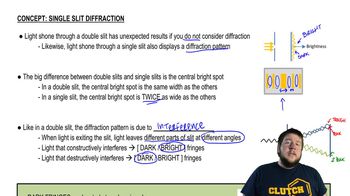
Single-slit diffraction occurs when light passes through a narrow opening, causing it to spread out and form a pattern of bright and dark fringes on a screen. The positions of the minima in this pattern can be calculated using the formula sin(θ) = mλ/D, where m is the order of the minimum, λ is the wavelength of light, and D is the slit width. This phenomenon is crucial for understanding how light behaves when constrained by physical barriers.
Video consigliato:
Percorso guidato
12:33
Single Slit Diffraciton

Temperature Dependence of Material Properties

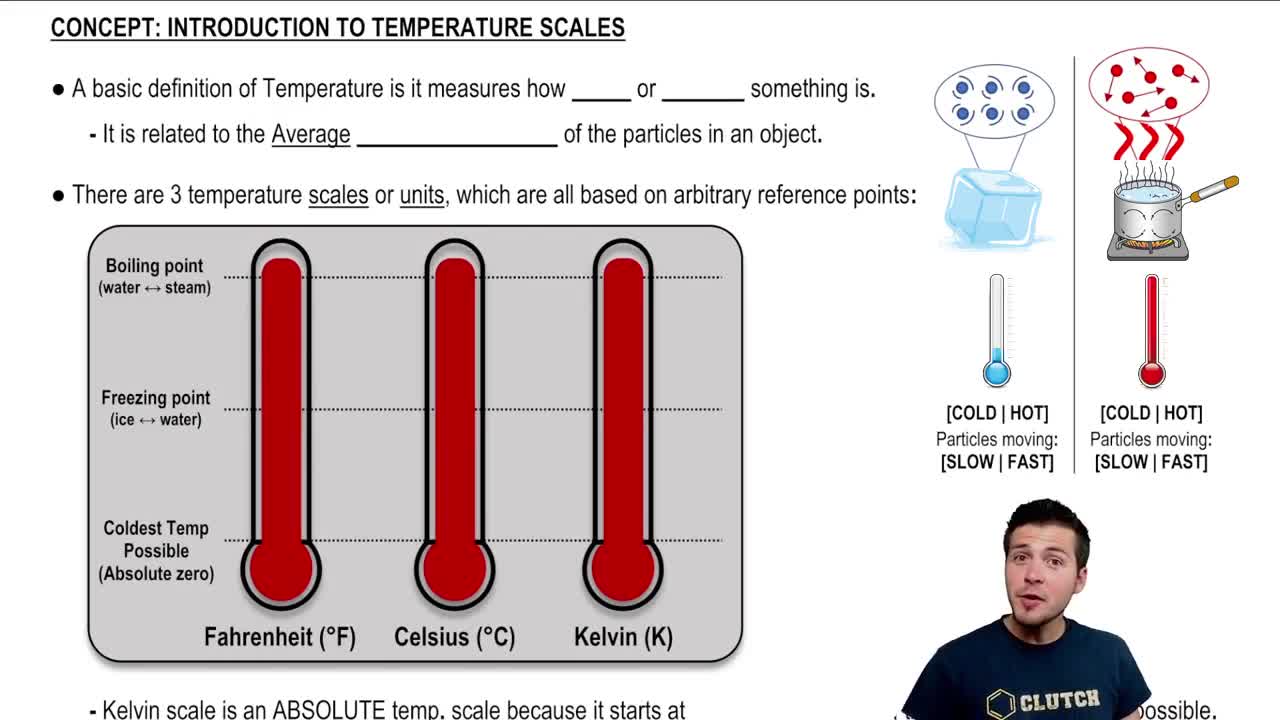
The properties of materials, including dimensions and refractive indices, can change with temperature. In this context, the width of the slit D may expand or contract with temperature changes, affecting the diffraction pattern. Understanding how temperature influences material properties is essential for accurately predicting changes in the diffraction pattern when the temperature of the aluminum plate is altered.
Video consigliato:
Percorso guidato
04:54
Introduction To Temperature Scales

Minima Position Calculation

The position of the minima in a diffraction pattern is determined by the angle at which destructive interference occurs. For small angles, the position of the first minima can be approximated as x = λℓ/D, where ℓ is the distance to the screen. This relationship allows us to calculate the distance between the minima and understand how changes in slit width or wavelength affect the diffraction pattern.
Video consigliato:
Percorso guidato
14:03
Rotational Position & Displacement