
Ch. 35 - Diffraction
Giancoli Douglas - Physics for Scientists and Engineers 5th edition
Giancoli Douglas5th editionPhysics for Scientists and EngineersISBN: 9780137488179Non è quello che usi tu?Cambia libro di testo
Capitolo 34, Problema 22

(a) Derive an expression for the intensity in the interference pattern for three equally spaced slits. Express in terms of δ = 2πd sin θ / λ where d is the distance between adjacent slits and assume the slit width D ≈ λ.
(b) Show that there is only one secondary maximum between principal peaks.

Guida verificata passo dopo passo
1
Start by recalling the general expression for the intensity in an interference pattern for multiple slits. The intensity is proportional to the square of the amplitude of the resultant wave. For three equally spaced slits, the resultant amplitude is the sum of the contributions from each slit, taking into account the phase difference δ between adjacent slits.
Write the expression for the resultant amplitude: \( A_{total} = A_1 + A_2 e^{i\delta} + A_3 e^{i2\delta} \), where \( A_1, A_2, A_3 \) are the amplitudes of the waves from the three slits, and \( \delta = \frac{2\pi d \sin \theta}{\lambda} \) is the phase difference between adjacent slits.
Simplify the expression for the resultant amplitude using the geometric series formula. Since the amplitudes are equal (\( A_1 = A_2 = A_3 = A \)), the resultant amplitude becomes \( A_{total} = A (1 + e^{i\delta} + e^{i2\delta}) \). Use the formula for the sum of a finite geometric series to simplify this further.
The intensity is proportional to the square of the magnitude of the resultant amplitude. Compute \( |A_{total}|^2 \) by taking the magnitude squared of the simplified amplitude expression. This will give the intensity as a function of \( \delta \): \( I(\delta) \propto |1 + e^{i\delta} + e^{i2\delta}|^2 \). Expand and simplify this expression to derive the final formula for intensity.
To show that there is only one secondary maximum between principal peaks, analyze the conditions for maxima. Principal maxima occur when \( \delta = 2n\pi \) (where \( n \) is an integer). For secondary maxima, find the values of \( \delta \) that satisfy the derivative of the intensity function \( I(\delta) \) being zero, excluding the principal maxima. Solve this condition and verify that there is only one secondary maximum between two consecutive principal maxima.

Risposta video verificata per un problema simile:

Questa soluzione video è stata consigliata dai nostri tutor come utile per risolvere questo problema.
Durata del video:
15m

Concetti chiave

Ecco i concetti essenziali che devi comprendere per rispondere correttamente alla domanda.

Interference Pattern

An interference pattern is created when waves from multiple sources overlap, leading to regions of constructive and destructive interference. In the case of slits, the path difference between waves emanating from different slits determines whether they reinforce or cancel each other. The resulting pattern consists of bright and dark fringes, which can be mathematically described using the phase difference between the waves.
Video consigliato:
Percorso guidato
03:47
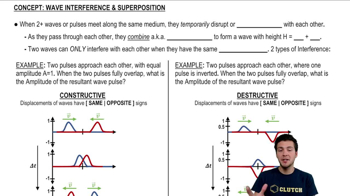
Wave Interference & Superposition

Path Difference and Phase Difference

The path difference is the difference in distance traveled by waves from different slits to a point on the screen. It is related to the phase difference, which is the fraction of a wavelength by which one wave lags behind another. The expression δ = 2πd sin θ / λ quantifies this relationship, where d is the distance between slits, θ is the angle of observation, and λ is the wavelength of the light used.
Video consigliato:

Secondary Maxima

Secondary maxima are the smaller peaks in an interference pattern that occur between the principal maxima. For three equally spaced slits, the conditions for these secondary maxima can be derived from the interference equations. The analysis shows that there is only one secondary maximum between each pair of principal peaks, which is a result of the specific phase relationships established by the three slits.
Video consigliato:
Percorso guidato
05:55
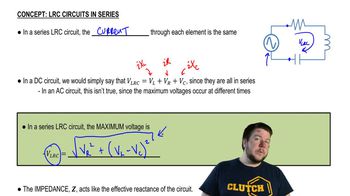
LRC Circuits in Series
Pratica correlata
Domanda del libro di testo

Explain why the secondary maxima in the single-slit diffraction pattern do not occur precisely at β/2 = (m + 1/2)π where m = 1, 2, 3, ... Carefully and precisely plot the curves y = β/2 and y = tan β/2. From their intersections, determine the values of β for the first and second secondary maxima. What is the percent difference from β/2 = (m + 1/2)π?

88
views
Domanda del libro di testo

(III) Derive an expression for the intensity in the interference pattern for three equally spaced slits. Express in terms of δ = 2πd sin θ / λ where d is the distance between adjacent slits and assume the slit width D ≈ λ . Show that there is only one secondary maximum between principal peaks.

1551
views
Domanda del libro di testo

In a double-slit experiment, let d = 5.00D = 40.0λ. Compare (as a ratio) the intensity of the third-order interference maximum with that of the zero-order maximum.

1504
views
Domanda del libro di testo

The nearest neighboring star to the Sun is about 4 light-years away. If a planet happened to be orbiting this star at an orbital radius equal to that of the Earth–Sun distance, what minimum diameter would an Earth-based telescope’s aperture have to be in order to obtain an image that resolved this star–planet system? Assume the light emitted by the star and planet has a wavelength of 550 nm.

87
views
Domanda del libro di testo

When driving at night, your eyes’ pupils have dilated to a 7.5-mm diameter. If your vision is diffraction limited, what would be the greatest distance at which you could resolve the two headlights of an oncoming car, which are spaced 1.5 m apart? Assume a wavelength of 550 nm for the light.

69
views
Domanda del libro di testo

Two 0.010-mm-wide slits are 0.030 mm apart (center to center). Determine (a) the spacing between interference fringes for 520-nm light on a screen 1.0 m away and (b) the distance between the two diffraction minima on either side of the central maximum of the envelope.

74
views