
Ch 04: Kinematics in Two Dimensions
Knight Calc - Physics for Scientists and Engineers 5th Edition
Knight Calc5th EditionPhysics for Scientists and EngineersISBN: 9780137344796Non è quello che usi tu?Cambia libro di testo
Capitolo 4, Problema 55b

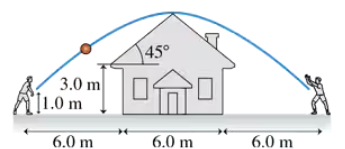
You're 6.0 m from one wall of the house seen in FIGURE P4.55. You want to toss a ball to your friend who is 6.0 m from the opposite wall. The throw and catch each occur 1.0 m above the ground. At what angle should you toss the ball?

Guida verificata passo dopo passo
1
Step 1: Identify the known values in the problem. The horizontal distance between you and your friend is the total distance between the walls, which is 6.0 m + 6.0 m = 12.0 m. The vertical displacement of the ball is zero because the throw and catch occur at the same height (1.0 m above the ground).
Step 2: Recall the kinematic equations for projectile motion. The horizontal motion is governed by the equation: x = vxt, where vx is the horizontal velocity component. The vertical motion is governed by: y = vyt - 12gt2, where g is the acceleration due to gravity.
Step 3: Break the initial velocity of the ball into components. The horizontal velocity is vx = v0⁢cos⁢θ, and the vertical velocity is vy = v0⁢sin⁢θ, where v0 is the initial speed and θ is the angle of the throw.
Step 4: Use the condition that the vertical displacement is zero to find the time of flight. Set y = 0 in the vertical motion equation and solve for t. This gives: t = 2v0⁢sin⁢θg.
Step 5: Substitute the time of flight into the horizontal motion equation to find the angle. Use x = vxt, and replace vx and t with their respective expressions in terms of v0 and θ. Solve for θ.

Risposta video verificata per un problema simile:

Questa soluzione video è stata consigliata dai nostri tutor come utile per risolvere questo problema.

Concetti chiave

Ecco i concetti essenziali che devi comprendere per rispondere correttamente alla domanda.

Projectile Motion

Projectile motion refers to the motion of an object that is thrown into the air and is subject to the force of gravity. It can be analyzed in two dimensions: horizontal and vertical. The horizontal motion is uniform, while the vertical motion is influenced by gravitational acceleration. Understanding the trajectory of the ball involves calculating the initial velocity, angle of projection, and the time of flight.
Video consigliato:
Percorso guidato
04:44
Introduction to Projectile Motion

Kinematic Equations

Kinematic equations describe the motion of objects under constant acceleration. In the context of projectile motion, these equations can be used to relate the initial velocity, angle of projection, time of flight, and displacement. For this problem, the horizontal and vertical components of the motion can be analyzed separately to determine the angle needed for the ball to reach the desired height and distance.
Video consigliato:
Percorso guidato
08:25
Kinematics Equations

Angle of Projection

The angle of projection is the angle at which an object is thrown relative to the horizontal. It significantly affects the range and height of the projectile. For a given initial speed, there is an optimal angle (typically 45 degrees) that maximizes the distance traveled. However, in this scenario, the specific angle must be calculated to ensure the ball reaches a height of 1.0 m while covering the horizontal distance of 12.0 m.
Video consigliato:
Pratica correlata
Domanda del libro di testo

You are watching an archery tournament when you start wondering how fast an arrow is shot from the bow. Remembering your physics, you ask one of the archers to shoot an arrow parallel to the ground. You find the arrow stuck in the ground 60 m away, making a 30° angle with the ground. How fast was the arrow shot?

2499
views
Domanda del libro di testo

While driving north at 25 m/s during a rainstorm you notice that the rain makes an angle of 38° with the vertical. While driving back home moments later at the same speed but in the opposite direction, you see that the rain is falling straight down. From these observations, determine the speed and angle of the raindrops relative to the ground.

2314
views
Domanda del libro di testo

A ball is thrown toward a cliff of height h with a speed of 30 m/s and an angle of 60° above horizontal. It lands on the edge of the cliff 4.0 s later. What was the maximum height of the ball?

2639
views
Domanda del libro di testo

Ships A and B leave port together. For the next two hours, ship A travels at 20 mph in a direction 30° west of north while ship B travels 20° east of north at 25 mph. What is the speed of ship A as seen by ship B?

2073
views
Domanda del libro di testo

A cannonball is fired at 100 m/s from a barrel tilted upward at 25°. What is the angle after the cannonball travels 500 m?

2370
views
Domanda del libro di testo

A ball is thrown toward a cliff of height h with a speed of 30 m/s and an angle of 60° above horizontal. It lands on the edge of the cliff 4.0 s later. What is the ball's impact speed?

2052
views