
Domanda del libro di testo
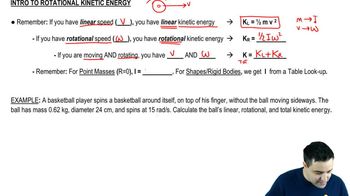
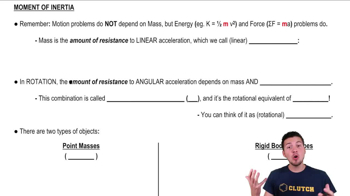
A thin, 100 g disk with a diameter of 8.0 cm rotates about an axis through its center with 0.15 J of kinetic energy. What is the speed of a point on the rim?
1687
views

 Guida verificata passo dopo passo
 06:07
06:07
 11:47
11:47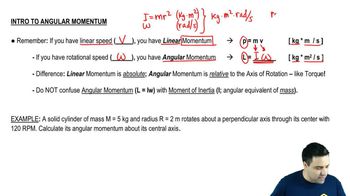 06:18
06:18A thin, 100 g disk with a diameter of 8.0 cm rotates about an axis through its center with 0.15 J of kinetic energy. What is the speed of a point on the rim?
The three 200 g masses in FIGURE EX12.11 are connected by massless, rigid rods. What is the triangle's kinetic energy if it rotates about the axis at 5.0 rev/s?
The four masses shown in FIGURE EX12.13 are connected by massless, rigid rods. Find the coordinates of the center of mass.
A ceiling fan with 80-cm-diameter blades is turning at 60 rpm. Suppose the fan coasts to a stop 25 s after being turned off. Through how many revolutions does the fan turn while stopping?
An 18-cm-long bicycle crank arm, with a pedal at one end, is attached to a 20-cm-diameter sprocket, the toothed disk around which the chain moves. A cyclist riding this bike increases her pedaling rate from 60 rpm to 90 rpm in 10 s. What is the tangential acceleration of a tooth on the sprocket?
Two balls are connected by a 150-cm-long massless rod. The center of mass is 35 cm from a 75 g ball on one end. What is the mass attached to the other end?