
Ch 20: The Micro/Macro Connection
Knight Calc - Physics for Scientists and Engineers 5th Edition
Knight Calc5th EditionPhysics for Scientists and EngineersISBN: 9780137344796Non è quello che usi tu?Cambia libro di testo
Capitolo 20, Problema 69a

n1 moles of a monatomic gas and n2 moles of a diatomic gas are mixed together in a container. Derive an expression for the molar specific heat at constant volume of the mixture.

Guida verificata passo dopo passo
1
Step 1: Recall the molar specific heat at constant volume (Cᵥ) for a monatomic gas and a diatomic gas. For a monatomic gas, Cᵥ₁ = (3/2)R, and for a diatomic gas, Cᵥ₂ = (5/2)R, where R is the universal gas constant.
Step 2: Understand that the molar specific heat of the mixture is a weighted average based on the number of moles of each type of gas. Let n₁ be the moles of the monatomic gas and n₂ be the moles of the diatomic gas.
Step 3: Write the total heat capacity of the mixture at constant volume as the sum of the contributions from each gas: Cᵥ_total = n₁Cᵥ₁ + n₂Cᵥ₂.
Step 4: Divide the total heat capacity by the total number of moles (n₁ + n₂) to find the molar specific heat of the mixture: Cᵥ_mixture = (n₁Cᵥ₁ + n₂Cᵥ₂) / (n₁ + n₂).
Step 5: Substitute the values of Cᵥ₁ and Cᵥ₂ into the expression: Cᵥ_mixture = (n₁(3/2)R + n₂(5/2)R) / (n₁ + n₂). Simplify the expression to derive the final formula for the molar specific heat at constant volume of the mixture.

Risposta video verificata per un problema simile:

Questa soluzione video è stata consigliata dai nostri tutor come utile per risolvere questo problema.
Durata del video:
5m

Concetti chiave

Ecco i concetti essenziali che devi comprendere per rispondere correttamente alla domanda.

Molar Specific Heat Capacity

Molar specific heat capacity is the amount of heat required to raise the temperature of one mole of a substance by one degree Celsius at constant volume. For gases, this value varies depending on the type of gas; monatomic gases typically have a specific heat of 3/2 R, while diatomic gases have a specific heat of 5/2 R, where R is the universal gas constant.
Video consigliato:
Percorso guidato
06:50
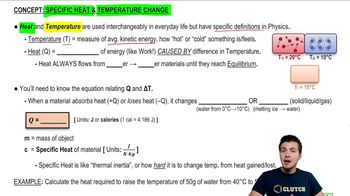
Specific Heat & Temperature Changes

Mixing of Gases

When different gases are mixed, the total specific heat capacity of the mixture can be calculated as a weighted average based on the number of moles of each gas. This involves considering the contributions of each gas's specific heat capacity and the respective moles present in the mixture, allowing for the derivation of an overall expression for the mixture's specific heat.
Video consigliato:
Percorso guidato
06:12
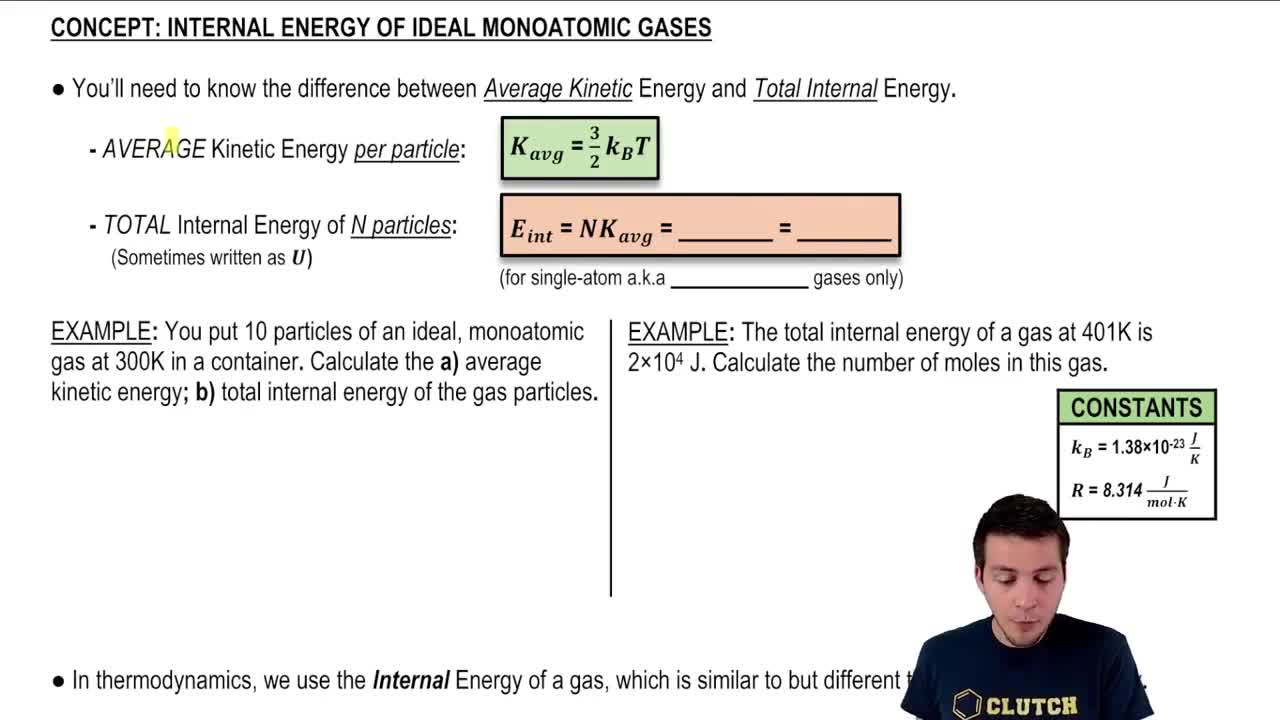
Internal Energy of Ideal Monoatomic Gases

Constant Volume Process

In a constant volume process, the volume of the gas does not change, meaning that any heat added to the system results in a change in temperature rather than work done by the gas. This condition is crucial for deriving the molar specific heat at constant volume, as it simplifies the relationship between heat transfer, temperature change, and specific heat capacity.
Video consigliato:
Percorso guidato
08:59
Phase Constant of a Wave Function
Pratica correlata
Domanda del libro di testo

Consider a container like that shown in Figure, with n1n_1 moles of a monatomic gas on one side and n2n_2 moles of a diatomic gas on the other. The monatomic gas has initial temperature T1iT_{1i}. The diatomic gas has initial temperature T2iT_{2i}. Show that the equilibrium thermal energies are

E1f=3n13n1+5n2(E1i+E2i)E2f=5n23n1+5n2(E1i+E2i)\(\begin{aligned}\) E_{1f} &= \(\frac{3n_1}{3n_1 + 5n_2}\) (E_{1i} + E_{2i}) \\ E_{2f} &= \(\frac{5n_2}{3n_1 + 5n_2}\) (E_{1i} + E_{2i}) \(\end{aligned}\)

1147
views
Domanda del libro di testo

n moles of a diatomic gas with Cv = 5/2 R has initial pressure pi and volume Vi. The gas undergoes a process in which the pressure is directly proportional to the volume until the rms speed of the molecules has doubled. How much heat does this process require? Give your answer in terms of n, pi and Vi.

175
views
Domanda del libro di testo

The rms speed of the molecules in 1.0 g of hydrogen gas is 1800 m/s. 500 J of work are done to compress the gas while, in the same process, 1200 J of heat energy are transferred from the gas to the environment. Afterward, what is the rms speed of the molecules?

1873
views
Domanda del libro di testo

The 2010 Nobel Prize in Physics was awarded for the discovery of graphene, a two-dimensional form of carbon in which the atoms form a two-dimensional crystal-lattice sheet only one atom thick. Predict the molar specific heat of graphene. Give your answer as a multiple of R.

1582
views
Domanda del libro di testo

An experiment you're designing needs a gas with γ = 1.50. You recall from your physics class that no individual gas has this value, but it occurs to you that you could produce a gas with γ = 1.50 by mixing together a monatomic gas and a diatomic gas. What fraction of the molecules need to be monatomic?

133
views
Domanda del libro di testo

A thin partition divides a container of volume V into two parts. One side contains nA moles of gas A in a fraction fA of the container; that is, VA = fAV. The other side contains nB moles of a different gas B at the same temperature in a fraction fB of the container. The partition is removed, allowing the gases to mix. Find an expression for the change of entropy. This is called the entropy of mixing.

1718
views