

The vibrational modes of molecular nitrogen are 'frozen out' at room temperature but become active at temperatures above ≈1500 K. The temperature in the combustion chamber of a jet engine can reach 2000 K, so an engineering analysis of combustion requires knowing the thermal properties of materials at these temperatures. What is the expected specific heat ratio γ for nitrogen at 2000 K?
Ch 20: The Micro/Macro Connection
Knight Calc5th EditionPhysics for Scientists and EngineersISBN: 9780137344796Non è quello che usi tu?Cambia libro di testo
Capitolo 20, Problema 26
The rms speed of the atoms in a 2.0 g sample of helium gas is 700 m/s. What is the thermal energy of the gas?
Guida verificata passo dopo passo1
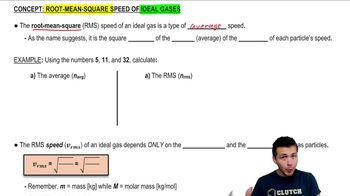
Step 1: Recall the formula for the root-mean-square (rms) speed of gas particles: , where is the Boltzmann constant, is the temperature, and is the mass of a single atom.
Step 2: Rearrange the formula to solve for the temperature : , where is the rms speed.
Step 3: Determine the mass of a single helium atom. The molar mass of helium is approximately 4.00 g/mol, and the mass of one atom is kg.
Step 4: Use the formula for the total thermal energy of a monatomic ideal gas: , where is the number of moles, is the gas constant, and is the temperature.
Step 5: Calculate the number of moles in the 2.0 g sample of helium using , where is the mass of the sample and is the molar mass. Substitute the values into the thermal energy formula to find the result.

Risposta video verificata per un problema simile:
Questa soluzione video è stata consigliata dai nostri tutor come utile per risolvere questo problema.
Concetti chiave
Ecco i concetti essenziali che devi comprendere per rispondere correttamente alla domanda.
Root Mean Square Speed
The root mean square (rms) speed is a statistical measure of the speed of particles in a gas. It is calculated as the square root of the average of the squares of the speeds of the individual particles. This concept is crucial for understanding the kinetic energy of gas particles, as it relates directly to their thermal motion and energy distribution.
Video consigliato:
Percorso guidato
Root-Mean-Square Speed of Ideal Gases
Thermal Energy
Thermal energy refers to the total kinetic energy of the particles in a substance due to their motion. In the context of gases, it can be calculated using the formula E = (3/2)nRT, where n is the number of moles, R is the ideal gas constant, and T is the temperature in Kelvin. Understanding thermal energy is essential for analyzing the energy content of gases and their behavior under different conditions.
Video consigliato:
Percorso guidato
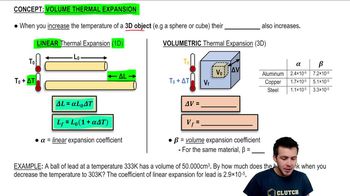
Volume Thermal Expansion
Ideal Gas Law
The Ideal Gas Law is a fundamental equation in thermodynamics that relates the pressure, volume, temperature, and number of moles of an ideal gas. It is expressed as PV = nRT. This law is important for calculating various properties of gases, including thermal energy, and helps in understanding how changes in one variable affect the others in a gas system.
Video consigliato:
Percorso guidato
Ideal Gases and the Ideal Gas Law
Pratica correlata
Domanda del libro di testo
2367
views
Domanda del libro di testo
By what factor does the rms speed of a molecule change if the temperature is increased from 10℃ to 1000℃?
1503
views
Domanda del libro di testo
A 6.0 m ✕ 8.0 m ✕ 3.0 m room contains air at 20℃. What is the room's thermal energy?
2083
views
Domanda del libro di testo
Liquid helium boils at 4.2 K. In a flask, the helium gas above the boiling liquid is at the same temperature. What are (a) the mean free path in the gas, (b) the rms speed of the atoms, and (c) the average energy per atom?
1786
views
Domanda del libro di testo
The thermal energy of 1.0 mol of a substance is increased by 1.0 J. What is the temperature change if the system is (a) a monatomic gas, (b) a diatomic gas, and (c) a solid?
1781
views
Domanda del libro di testo
1.0 mol of argon has 3100 J of thermal energy. What is the gas temperature in °C?
1862
views
