
Ch 20: The Micro/Macro Connection
Knight Calc - Physics for Scientists and Engineers 5th Edition
Knight Calc5th EditionPhysics for Scientists and EngineersISBN: 9780137344796Non è quello che usi tu?Cambia libro di testo
Capitolo 20, Problema 29

The thermal energy of 1.0 mol of a substance is increased by 1.0 J. What is the temperature change if the system is (a) a monatomic gas, (b) a diatomic gas, and (c) a solid?

Guida verificata passo dopo passo
1
Step 1: Understand the relationship between thermal energy, temperature change, and heat capacity. The formula to use is ΔQ = n * C * ΔT, where ΔQ is the thermal energy added, n is the number of moles, C is the molar heat capacity, and ΔT is the temperature change.
Step 2: For a monatomic gas, the molar heat capacity at constant volume (C_v) is given by C_v = (3/2) * R, where R is the universal gas constant (R ≈ 8.314 J/(mol·K)). Substitute C_v into the formula ΔQ = n * C_v * ΔT and solve for ΔT.
Step 3: For a diatomic gas, the molar heat capacity at constant volume (C_v) is given by C_v = (5/2) * R. Substitute this value into the formula ΔQ = n * C_v * ΔT and solve for ΔT.
Step 4: For a solid, the molar heat capacity is typically approximated using the Dulong-Petit law, which states C ≈ 3 * R. Substitute this value into the formula ΔQ = n * C * ΔT and solve for ΔT.
Step 5: For each case (monatomic gas, diatomic gas, and solid), substitute the given values: ΔQ = 1.0 J and n = 1.0 mol into the respective formulas derived in steps 2, 3, and 4 to calculate the temperature change ΔT for each system.

Risposta video verificata per un problema simile:

Questa soluzione video è stata consigliata dai nostri tutor come utile per risolvere questo problema.
Durata del video:
5m

Concetti chiave

Ecco i concetti essenziali che devi comprendere per rispondere correttamente alla domanda.

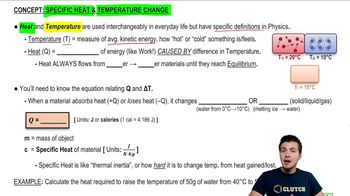
Specific Heat Capacity

Specific heat capacity is the amount of heat required to change the temperature of a unit mass of a substance by one degree Celsius. It varies for different materials and phases (solid, liquid, gas) and is crucial for calculating temperature changes when thermal energy is added or removed.
Video consigliato:
Percorso guidato
06:50
Specific Heat & Temperature Changes

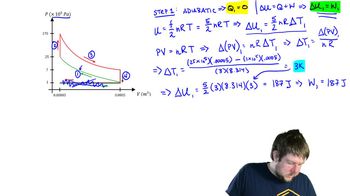
Degrees of Freedom

Degrees of freedom refer to the number of independent ways in which a system can store energy. For gases, monatomic gases have three translational degrees of freedom, while diatomic gases have five (three translational and two rotational). This affects how they respond to added thermal energy.
Video consigliato:
Percorso guidato
17:42
Finding the Compression Ratio

Heat Transfer in Phases

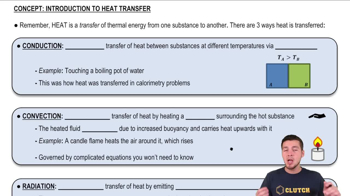
Heat transfer in phases describes how different states of matter (solid, liquid, gas) absorb and transfer heat. Solids typically have lower heat capacities compared to gases, and the way energy is distributed among particles varies significantly, influencing the temperature change for a given amount of thermal energy.
Video consigliato:
Percorso guidato
05:14
Overview of Heat Transfer
Pratica correlata
Domanda del libro di testo

Your calculator can't handle enormous exponents, but we can make sense of large powers of e by converting them to large powers of 10. If we write e = 10α, then eβ = (10α)β = 10αβ. What is the multiplicity of a macrostate with entropy S = 1.0 J/K? Give your answer as a power of 10.

1163
views
Domanda del libro di testo

The vibrational modes of molecular nitrogen are 'frozen out' at room temperature but become active at temperatures above ≈1500 K. The temperature in the combustion chamber of a jet engine can reach 2000 K, so an engineering analysis of combustion requires knowing the thermal properties of materials at these temperatures. What is the expected specific heat ratio γ for nitrogen at 2000 K?

2367
views
Domanda del libro di testo

2.0 mol of monatomic gas A initially has 5000 J of thermal energy. It interacts with 3.0 mol of monatomic gas B, which initially has 8000 J of thermal energy. Which gas has the higher initial temperature?

1760
views
Domanda del libro di testo

The rms speed of the atoms in a 2.0 g sample of helium gas is 700 m/s. What is the thermal energy of the gas?

1933
views
Domanda del libro di testo

A 6.0 m ✕ 8.0 m ✕ 3.0 m room contains air at 20℃. What is the room's thermal energy?

2083
views
Domanda del libro di testo

Liquid helium boils at 4.2 K. In a flask, the helium gas above the boiling liquid is at the same temperature. What are (a) the mean free path in the gas, (b) the rms speed of the atoms, and (c) the average energy per atom?

1786
views