Ch 21: Heat Engines and Refrigerators
Knight Calc - Physics for Scientists and Engineers 5th Edition
Knight Calc5th EditionPhysics for Scientists and EngineersISBN: 9780137344796Non è quello che usi tu?Cambia libro di testo
Capitolo 21, Problema 19b

An air conditioner removes 5.0 x 10⁵ J/min of heat from a house and exhausts 8.0 x 10⁵ J/min to the hot outdoors. What is the air conditioner's coefficient of performance?

Guida verificata passo dopo passo
1
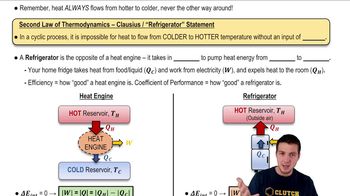
The coefficient of performance (COP) for a cooling device is defined as the ratio of the heat removed from the cold reservoir (house) to the work input required to operate the device. Mathematically, it is expressed as: COP=QcW, where Qc is the heat removed from the cold reservoir and W is the work input.
The work input W can be determined using the first law of thermodynamics, which states that the total energy input to the system is equal to the sum of the heat removed from the cold reservoir and the heat exhausted to the hot reservoir. Mathematically: W=Qh-Qc, where Qh is the heat exhausted to the hot reservoir.
Substitute the given values into the equation for work: W=(8.0×10⁵)-(5.0×10⁵). This will give the value of W in joules per minute.
Now, substitute the values of Qc and W into the COP formula: COP=(5.0×10⁵)(Qc).
Simplify the expression to calculate the coefficient of performance (COP). This will give you the final value of the air conditioner's COP.

Risposta video verificata per un problema simile:

Questa soluzione video è stata consigliata dai nostri tutor come utile per risolvere questo problema.
Durata del video:
3m

Concetti chiave

Ecco i concetti essenziali che devi comprendere per rispondere correttamente alla domanda.

Coefficient of Performance (COP)

The Coefficient of Performance (COP) is a measure of the efficiency of a heat pump or air conditioning system. It is defined as the ratio of the heat removed from the cooled space (useful output) to the work input (energy consumed) required to remove that heat. A higher COP indicates a more efficient system, as it means more heat is removed per unit of energy consumed.
Video consigliato:

Heat Transfer

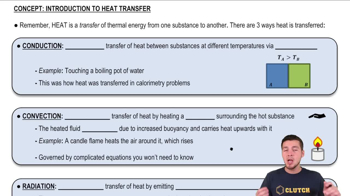
Heat transfer refers to the movement of thermal energy from one physical system to another. In the context of air conditioning, it involves the removal of heat from the indoor environment and its release to the outdoor environment. Understanding the principles of heat transfer, including conduction, convection, and radiation, is essential for analyzing the performance of HVAC systems.
Video consigliato:
Percorso guidato
05:14
Overview of Heat Transfer

Energy Units and Conversion

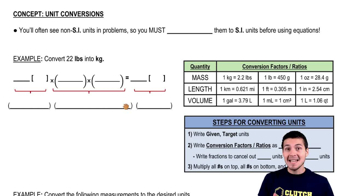
In physics, energy is often measured in joules (J), and understanding how to convert between different units of energy and power is crucial for solving problems related to energy consumption. In this case, the air conditioner’s heat removal and exhaust rates are given in joules per minute, which may need to be converted to a consistent unit when calculating the COP. Familiarity with these conversions ensures accurate calculations and comparisons.
Video consigliato:
Percorso guidato
07:46
Unit Conversions