
Ch 23: The Electric Field
Knight Calc - Physics for Scientists and Engineers 5th Edition
Knight Calc5th EditionPhysics for Scientists and EngineersISBN: 9780137344796Non è quello che usi tu?Cambia libro di testo
Capitolo 23, Problema 3

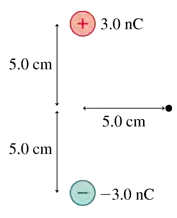
What are the strength and direction of the electric field at the position indicated by the dot in FIGURE EX23.3? Specify the direction as an angle cw from horizontal.
Diagram showing two charges, +3.0 nC above and -3.0 nC below, with a dot indicating the electric field's strength and direction.

Guida verificata passo dopo passo
1
Step 1: Understand the problem. The dot represents the point where the electric field strength and direction need to be calculated. The electric field at a point due to a charge is given by the formula: E=kqr2, where k is Coulomb's constant (8.99×10⁹N·m2/C2), q is the charge, and r is the distance from the charge to the point.
Step 2: Calculate the electric field due to the positive charge. The positive charge is 3.0nC and is located 5.0cm vertically above the dot. Convert the distance to meters: 5.0×10⁻²m. Use the formula for electric field to find the magnitude of the field due to this charge.
Step 3: Calculate the electric field due to the negative charge. The negative charge is -3.0nC and is located 5.0cm vertically below the dot. Again, convert the distance to meters and use the formula for electric field to find the magnitude of the field due to this charge.
Step 4: Determine the direction of the electric fields. The electric field due to the positive charge points away from the positive charge, while the electric field due to the negative charge points toward the negative charge. Both fields are vertical, one pointing downward and the other upward. Calculate the net vertical component of the electric field.
Step 5: Combine the vertical and horizontal components of the electric field. The horizontal component comes from the horizontal distance between the dot and the charges. Use vector addition to find the resultant electric field and calculate its direction as an angle clockwise from the horizontal using trigonometry (tan¯(verticalhorizontal)).

Risposta video verificata per un problema simile:

Questa soluzione video è stata consigliata dai nostri tutor come utile per risolvere questo problema.

Concetti chiave

Ecco i concetti essenziali che devi comprendere per rispondere correttamente alla domanda.

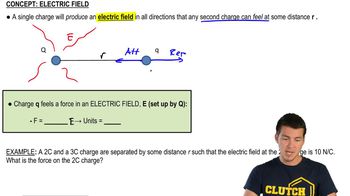
Electric Field

The electric field is a vector field that represents the force exerted by an electric charge on other charges in its vicinity. It is defined as the force per unit charge and is directed away from positive charges and toward negative charges. The strength of the electric field (E) can be calculated using the formula E = F/q, where F is the force experienced by a test charge q placed in the field.
Video consigliato:
Percorso guidato
03:16
Intro to Electric Fields

Superposition Principle

The superposition principle states that the total electric field created by multiple charges is the vector sum of the electric fields produced by each charge independently. This means that to find the net electric field at a point, one must calculate the electric field due to each charge and then add these vectorially, taking into account their magnitudes and directions.
Video consigliato:
Percorso guidato
03:32
Superposition of Sinusoidal Wave Functions

Vector Components

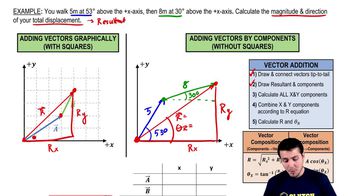
Vectors can be broken down into their components along the axes of a coordinate system, typically the x and y axes. This is crucial for analyzing electric fields, as the direction of the field can be expressed in terms of its horizontal and vertical components. The angle of the resultant vector can then be determined using trigonometric functions, allowing for a clear understanding of the field's direction.
Video consigliato:
Percorso guidato
07:30
Vector Addition By Components