
Ch 24: Gauss' Law
Knight Calc - Physics for Scientists and Engineers 5th Edition
Knight Calc5th EditionPhysics for Scientists and EngineersISBN: 9780137344796Non è quello che usi tu?Cambia libro di testo
Capitolo 24, Problema 45b

An infinite slab of charge of thickness 2𝒵₀ lies in the xy-plane between 𝒵 = -𝒵₀ and 𝒵 = +𝒵₀ . The volume charge density p (C/m3) is a constant. Find an expression for the electric field strength above the slab (𝒵 ≥ 𝒵₀).

Guida verificata passo dopo passo
1
Start by recognizing that the problem involves a uniformly charged infinite slab, and we need to find the electric field above the slab (𝒵 ≥ 𝒵₀). Use Gauss's law, which states: ∮𝐄·d𝐀 = Q_enclosed/ε₀, where Q_enclosed is the charge enclosed by the Gaussian surface, and ε₀ is the permittivity of free space.
Choose an appropriate Gaussian surface. For this problem, a cylindrical Gaussian surface (pillbox) is ideal. Place the pillbox such that it extends above the slab into the region 𝒵 ≥ 𝒵₀ and partially inside the slab. The flat surfaces of the pillbox are parallel to the xy-plane, and the curved surface does not contribute to the flux because the electric field is perpendicular to it.
Calculate the charge enclosed by the Gaussian surface. The volume of the slab enclosed by the pillbox is the cross-sectional area A of the pillbox multiplied by the thickness of the slab within the pillbox (from -𝒵₀ to +𝒵₀). The charge enclosed is Q_enclosed = p × A × (𝒵 - 𝒵₀), where p is the volume charge density and (𝒵 - 𝒵₀) is the thickness of the slab within the pillbox.
Apply Gauss's law. The electric flux through the pillbox is given by ∮𝐄·d𝐀 = E × A (since the electric field is uniform and perpendicular to the surface). Substituting this and the expression for Q_enclosed into Gauss's law gives: E × A = (p × A × (𝒵 - 𝒵₀))/ε₀.
Simplify the expression to solve for the electric field strength E. Cancel out the area A from both sides of the equation, leaving E = (p × (𝒵 - 𝒵₀))/ε₀. This is the expression for the electric field strength above the slab (𝒵 ≥ 𝒵₀).

Risposta video verificata per un problema simile:

Questa soluzione video è stata consigliata dai nostri tutor come utile per risolvere questo problema.
Durata del video:
7m

Concetti chiave

Ecco i concetti essenziali che devi comprendere per rispondere correttamente alla domanda.

Electric Field Due to a Continuous Charge Distribution

The electric field generated by a continuous charge distribution, such as an infinite slab, can be calculated using Gauss's law. This law relates the electric flux through a closed surface to the charge enclosed by that surface. For an infinite slab, the electric field is uniform and directed perpendicular to the surface, depending on the charge density and the distance from the slab.
Video consigliato:
Percorso guidato
06:55
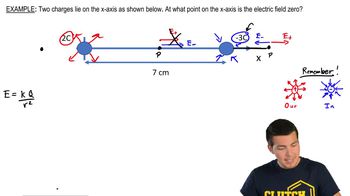
Zero Electric Field due to Two Charges

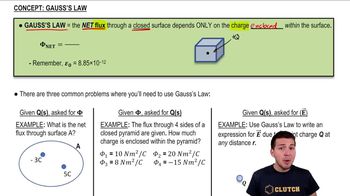
Gauss's Law

Gauss's law states that the total electric flux through a closed surface is equal to the enclosed charge divided by the permittivity of free space. This principle is particularly useful for calculating electric fields in symmetrical charge distributions, such as planes, cylinders, and spheres. By choosing an appropriate Gaussian surface, one can simplify the calculations significantly.
Video consigliato:

Superposition Principle

The superposition principle states that the total electric field created by multiple charge distributions is the vector sum of the electric fields produced by each distribution individually. In the case of an infinite slab, the electric field above the slab can be determined by considering the contributions from both the positive and negative sides of the slab, allowing for a straightforward calculation of the resultant field.
Video consigliato:
Percorso guidato
03:32
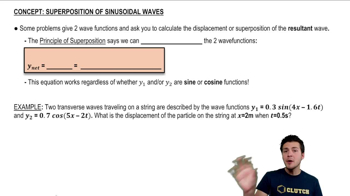
Superposition of Sinusoidal Wave Functions
Pratica correlata
Domanda del libro di testo

An infinitely wide, horizontal metal plate lies above a horizontal infinite sheet of charge with surface charge density 800 nC/m2. The bottom surface of the plate has surface charge density -100 nC/m2. What is the surface charge density on the top surface of the plate?

1693
views
Domanda del libro di testo

An infinite slab of charge is centered in the xy-plane. It has charge density ρ=ρ0e−∣z∣/ze\(\rho\)=\(\rho\)_0e^{-|z|/z_{e}}, where ρ₀ and z₀ are constants. This is a charge density that decreases exponentially as you move away from z = 0 in either the positive or negative direction. Find the electric field strength at distance z from the center of the slab.

149
views
Domanda del libro di testo

The three parallel planes of charge shown in FIGURE P24.44 have surface charge densities ─ ½ η , η , and ─ ½ η. Find the electric fields EA→\(\overrightarrow{E_{A}\)} to ED→\(\overrightarrow{E_{D}\)} in regions A to D. The upward direction is the + y-direction.

2230
views
Domanda del libro di testo

FIGURE P24.46 shows an infinitely wide conductor parallel to and distance d from an infinitely wide plane of charge with surface charge density η. What are the electric fields EA→\(\overrightarrow{E_{A}\)} to ED→\(\overrightarrow{E_{D}\)} in regions A to D?

200
views
Domanda del libro di testo

Figure 24.32b showed a conducting box inside a parallel-plate capacitor. The electric field inside the box is E→=0→\(\overrightarrow{E}\)=\(\overrightarrow{0}\). Suppose the surface charge on the exterior of the box could be frozen. Draw a picture of the electric field inside the box after the box, with its frozen charge, is removed from the capacitor. Hint: Superposition.

1332
views
Domanda del libro di testo

An early model of the atom, proposed by Rutherford after his discovery of the atomic nucleus, had a positive point charge + Ze (the nucleus) at the center of a sphere of radius R with uniformly distributed negative charge -Ze. Z is the atomic number, the number of protons in the nucleus and the number of electrons in the negative sphere. A uranium atom has Z = 92 and 𝑅 = 0.10nm . What is the electric field strength at r = ½𝑅?

195
views