Ch 25: The Electric Potential
Knight Calc - Physics for Scientists and Engineers 5th Edition
Knight Calc5th EditionPhysics for Scientists and EngineersISBN: 9780137344796Non è quello che usi tu?Cambia libro di testo
Capitolo 25, Problema 35

The two halves of the rod in FIGURE EX25.35 are uniformly charged to ±Q. What is the electric potential at the point indicated by the dot?
Diagram showing a uniformly charged rod with a point marked above it, indicating distance 'd' from the rod.

Guida verificata passo dopo passo
1
Identify the symmetry of the problem: The rod is divided into two halves, one positively charged (+Q) and the other negatively charged (-Q). The point of interest lies along the axis of symmetry of the rod, simplifying the calculation of the electric potential.
Recall the formula for the electric potential due to a point charge: \( V = \frac{kQ}{r} \), where \( k \) is Coulomb's constant, \( Q \) is the charge, and \( r \) is the distance from the charge to the point of interest. For a continuous charge distribution, the potential is calculated by integrating over the charge distribution.
Set up the integral for the electric potential: Divide the rod into infinitesimal charge elements \( dq \). For each element, the potential contribution at the point is \( dV = \frac{k dq}{r} \), where \( r \) is the distance from the charge element to the point. Integrate this expression over the length of each half of the rod.
Express \( dq \) in terms of the linear charge density \( \lambda \): The linear charge density is \( \lambda = \frac{Q}{L} \), where \( L \) is the length of each half of the rod. Thus, \( dq = \lambda dx \), where \( dx \) is an infinitesimal length element of the rod.
Perform the integration for each half of the rod: For the positively charged half, integrate \( \frac{k \lambda dx}{r} \) over its length. For the negatively charged half, do the same but with a negative charge density. Add the contributions from both halves to find the total electric potential at the point.

Risposta video verificata per un problema simile:

Questa soluzione video è stata consigliata dai nostri tutor come utile per risolvere questo problema.

Concetti chiave

Ecco i concetti essenziali che devi comprendere per rispondere correttamente alla domanda.

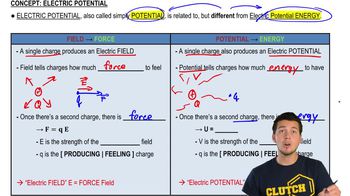
Electric Potential

Electric potential, often referred to as voltage, is the amount of electric potential energy per unit charge at a specific point in an electric field. It is a scalar quantity measured in volts (V) and indicates the work done to move a unit positive charge from a reference point to the specified point without any acceleration.
Video consigliato:
Percorso guidato
07:33
Electric Potential

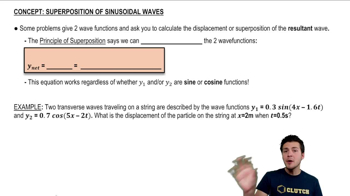
Superposition Principle

The superposition principle states that the total electric potential at a point due to multiple charge distributions is the algebraic sum of the potentials due to each charge considered independently. This principle allows us to calculate the net electric potential by adding the contributions from each charged object, taking into account their respective distances from the point of interest.
Video consigliato:
Percorso guidato
03:32
Superposition of Sinusoidal Wave Functions

Uniform Charge Distribution

Uniform charge distribution refers to a scenario where charge is spread evenly over a given length, area, or volume. In the context of the rod described, each half is uniformly charged to ±Q, meaning that the charge density is constant along the length of each half. This uniformity simplifies calculations of electric fields and potentials, as the effects of each segment can be treated uniformly.
Video consigliato:
Percorso guidato
04:03
Probability Distribution Graph