Ch 01: Units, Physical Quantities & Vectors
Young & Freedman Calc - University Physics 14th Edition
Young & Freedman Calc14th EditionUniversity PhysicsISBN: 9780321973610Non è quello che usi tu?Cambia libro di testo
Capitolo 1, Problema 34a

Find the magnitude and direction of the vector represented by the following pairs of components: Ax = −8.60 cm, Ay = 5.20 cm

Guida verificata passo dopo passo
1
Step 1: Understand that the vector components Ax and Ay represent the horizontal and vertical components of the vector, respectively. The magnitude of the vector can be found using the Pythagorean theorem.
Step 2: Use the formula for the magnitude of a vector: A2+B2, where A and B are the components Ax and Ay. Substitute Ax = -8.60 cm and Ay = 5.20 cm into the formula.
Step 3: Calculate the magnitude of the vector using the formula: -8.602+5.202 cm.
Step 4: Determine the direction of the vector using the tangent function. The direction angle θ can be found using the formula: θ=tan-1(AyAx). Substitute Ax = -8.60 cm and Ay = 5.20 cm into the formula.
Step 5: Calculate the direction angle θ using the formula: θ=tan-1(5.20-8.60). Consider the signs of Ax and Ay to determine the correct quadrant for the angle.

Risposta video verificata per un problema simile:

Questa soluzione video è stata consigliata dai nostri tutor come utile per risolvere questo problema.
Durata del video:
5m

Concetti chiave

Ecco i concetti essenziali che devi comprendere per rispondere correttamente alla domanda.

Vector Magnitude

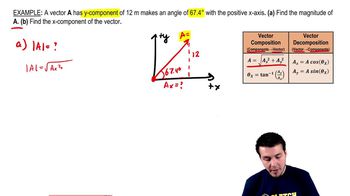
The magnitude of a vector is a measure of its length and is calculated using the Pythagorean theorem. For a vector with components Ax and Ay, the magnitude is given by the formula √(Ax² + Ay²). This provides a scalar quantity representing the size of the vector irrespective of its direction.
Video consigliato:
Percorso guidato
03:59
Calculating Magnitude & Components of a Vector

Vector Direction

The direction of a vector is determined by the angle it makes with a reference axis, typically the positive x-axis. This angle, θ, can be found using trigonometry, specifically the tangent function: θ = arctan(Ay/Ax). The angle provides insight into the vector's orientation in a coordinate system.
Video consigliato:
Percorso guidato
06:44
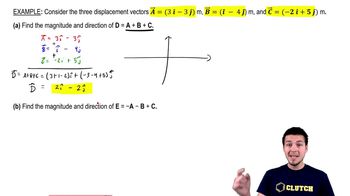
Adding 3 Vectors in Unit Vector Notation

Coordinate System

Understanding the coordinate system is crucial for interpreting vector components. In a Cartesian coordinate system, vectors are expressed in terms of their horizontal (x-axis) and vertical (y-axis) components. This system allows for the decomposition and analysis of vectors in two dimensions, facilitating calculations of magnitude and direction.
Video consigliato:
Percorso guidato
05:17
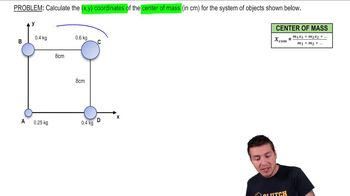
Coordinates of Center of Mass of 4 objects
Pratica correlata
Domanda del libro di testo

Given two vectors A = 4i + 7j and B = 5i - 2j, find the magnitude of each vector.

3061
views

Domanda del libro di testo

In each case, find the x- and y- components of vector A: A = 11.2j - 9.91i

3083
views
Domanda del libro di testo

Vector A is 2.80 cm long and is 60.0° above the x-axis in the first quadrant. Vector B is 1.90 cm long and is 60.0° below the x-axis in the fourth quadrant (Fig. E1.35). Use components to find the magnitude and direction of A - B In each case, sketch the vector addition or subtraction and show that your numerical answers are in qualitative agreement with your sketch.


6307
views
1
comments
Domanda del libro di testo

A disoriented physics professor drives 3.25 km north, then 2.20 km west, and then 1.50 km south. Find the magnitude and direction of the resultant displacement, using the method of components. In a vector-addition diagram (roughly to scale), show that the resultant displacement found from your diagram is in qualitative agreement with the result you obtained by using the method of components.

3393
views
1
rank
Domanda del libro di testo

A postal employee drives a delivery truck over the route shown in Fig. E1.25. Use the method of components to determine the magnitude and direction of her resultant displacement. In a vector-addition diagram (roughly to scale), show that the resultant displacement found from your diagram is in qualitative agreement with the result you obtained by using the method of components.

4472
views
1
rank
1
comments
Domanda del libro di testo

For the vectors A and B in Fig. E1.24 use the method of components to find the magnitude and direction of the vector difference B - A


2915
views