
Ch 02: Motion Along a Straight Line
Young & Freedman Calc - University Physics 14th Edition
Young & Freedman Calc14th EditionUniversity PhysicsISBN: 9780321973610Non è quello che usi tu?Cambia libro di testo
Capitolo 2, Problema 36a

A small rock is thrown vertically upward with a speed of 22.022.0 m/s from the edge of the roof of a 30.030.0-m-tall building. The rock doesn't hit the building on its way back down and lands on the street below. Ignore air resistance. What is the speed of the rock just before it hits the street?

Guida verificata passo dopo passo
1
Identify the initial conditions: The initial velocity of the rock is 22.0 m/s upward, and it is thrown from a height of 30.0 m above the street.
Use the kinematic equation for velocity to find the final speed just before the rock hits the street. The equation is: v=v0+gt, where v is the final velocity, v0 is the initial velocity, g is the acceleration due to gravity (approximately 9.81 m/s²), and t is the time of flight.
To find the time of flight, use the kinematic equation for displacement: y=y0+v0t+12gt^2, where y is the final position (0 m, since it lands on the street), y0 is the initial position (30.0 m), and solve for t.
Substitute the value of t obtained from the displacement equation into the velocity equation to find the final velocity v.
Remember that the final speed is the magnitude of the final velocity, so take the absolute value of v to find the speed just before the rock hits the street.

Risposta video verificata per un problema simile:

Questa soluzione video è stata consigliata dai nostri tutor come utile per risolvere questo problema.
Durata del video:
3m

Concetti chiave

Ecco i concetti essenziali che devi comprendere per rispondere correttamente alla domanda.

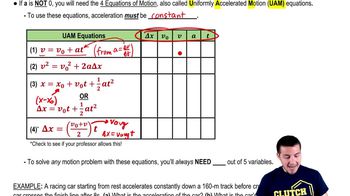
Kinematics Equations

Kinematics equations describe the motion of objects without considering the forces that cause the motion. For vertical motion, these equations relate initial velocity, final velocity, acceleration due to gravity, displacement, and time. They are essential for calculating the speed of the rock just before it hits the street.
Video consigliato:
Percorso guidato
08:25
Kinematics Equations

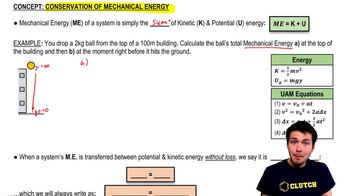
Conservation of Energy

The principle of conservation of energy states that energy cannot be created or destroyed, only transformed. In this scenario, the rock's initial kinetic energy and potential energy are converted into kinetic energy as it falls. This concept helps determine the rock's speed upon impact by equating initial and final energy states.
Video consigliato:
Percorso guidato
06:24
Conservation Of Mechanical Energy

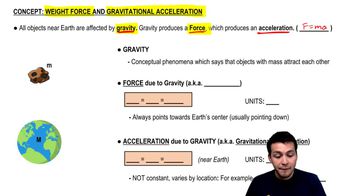
Gravitational Acceleration

Gravitational acceleration is the acceleration of an object due to Earth's gravity, approximately 9.81 m/s² downward. It affects the rock's motion as it travels upward and downward, influencing its velocity and displacement. Understanding this constant is crucial for applying kinematics equations to solve the problem.
Video consigliato:
Percorso guidato
07:32
Weight Force & Gravitational Acceleration
Pratica correlata