
High-speed motion pictures ( frames/second) of a jumping, flea yielded the data used to plot the graph in Fig. E. (See 'The Flying Leap of the Flea' by M. Rothschild, Y. Schlein, K. Parker, C. Neville, and S. Sternberg in the November Scientific American.) This flea was about mm long and jumped at a nearly vertical takeoff angle. Use the graph to answer this question: Is the acceleration of the flea ever zero? If so, when? Justify your answer.
Young & Freedman Calc 14th Edition
Ch 02: Motion Along a Straight Line
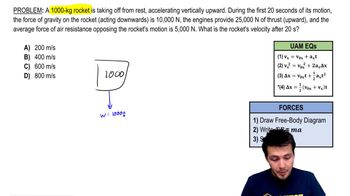
Problema 62bA small rocket burns 0.0500 kg of fuel per second, ejecting it as a gas with a velocity relative to the rocket of magnitude 1600 m/s. Would the rocket operate in outer space where there is no atmosphere? If so, how would you steer it? Could you brake it?
Guida verificata passo dopo passo
Risposta video verificata per un problema simile:
Concetti chiave
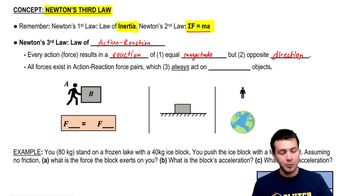
Newton's Third Law of Motion
Rocket Propulsion
Steering and Braking in Space
High-speed motion pictures ( frames/second) of a jumping, flea yielded the data used to plot the graph in Fig. E. (See 'The Flying Leap of the Flea' by M. Rothschild, Y. Schlein, K. Parker, C. Neville, and S. Sternberg in the November Scientific American.) This flea was about mm long and jumped at a nearly vertical takeoff angle. Use the graph to answer this question: Find the flea's acceleration at ms, ms, and ms.
High-speed motion pictures ( frames/second) of a jumping, flea yielded the data used to plot the graph in Fig. E. (See 'The Flying Leap of the Flea' by M. Rothschild, Y. Schlein, K. Parker, C. Neville, and S. Sternberg in the November Scientific American.) This flea was about mm long and jumped at a nearly vertical takeoff angle. Use the graph to answer this question: Find the maximum height the flea reached in the first ms.