Ch 02: Motion Along a Straight Line
Young & Freedman Calc - University Physics 14th Edition
Young & Freedman Calc14th EditionUniversity PhysicsISBN: 9780321973610Non è quello che usi tu?Cambia libro di testo
Capitolo 2, Problema 22a

In the fastest measured tennis serve, the ball left the racquet at 73.1473.14 m/s. A served tennis ball is typically in contact with the racquet for 30.030.0 ms and starts from rest. Assume constant acceleration. What was the ball's acceleration during this serve?

Guida verificata passo dopo passo
1
Identify the known values: initial velocity (v₀) = 0 m/s (since the ball starts from rest), final velocity (v) = 73.14 m/s, and time (t) = 30.0 ms = 0.030 s.
Use the formula for acceleration under constant acceleration: a = (v - v₀) / t.
Substitute the known values into the formula: a = (73.14 m/s - 0 m/s) / 0.030 s.
Simplify the expression to find the acceleration: a = 73.14 m/s / 0.030 s.
The result from the simplification will give you the acceleration of the ball during the serve.

Risposta video verificata per un problema simile:

Questa soluzione video è stata consigliata dai nostri tutor come utile per risolvere questo problema.
Durata del video:
1m

Concetti chiave

Ecco i concetti essenziali che devi comprendere per rispondere correttamente alla domanda.

Kinematics Equations

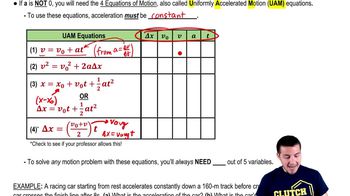
Kinematics equations describe the motion of objects under constant acceleration. They relate displacement, initial velocity, final velocity, acceleration, and time. In this problem, the equation v = u + at is crucial, where v is the final velocity, u is the initial velocity, a is the acceleration, and t is the time.
Video consigliato:
Percorso guidato
08:25
Kinematics Equations

Constant Acceleration

Constant acceleration means that the rate of change of velocity is uniform over time. This simplifies calculations as the acceleration value remains the same throughout the motion. In this scenario, the ball's acceleration is constant while in contact with the racquet, allowing us to use kinematic equations effectively.
Video consigliato:
Percorso guidato
08:59
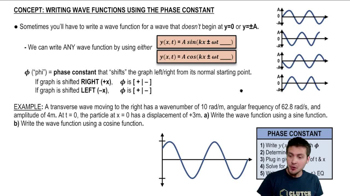
Phase Constant of a Wave Function

Unit Conversion

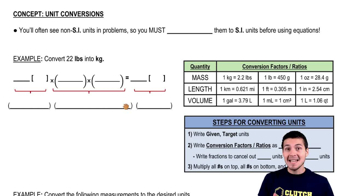
Unit conversion is essential for ensuring consistency in calculations. In this problem, time is given in milliseconds, which must be converted to seconds (1 ms = 0.001 s) to match the standard SI units used in kinematic equations. This ensures accurate computation of acceleration.
Video consigliato:
Percorso guidato
07:46
Unit Conversions
Pratica correlata
Domanda del libro di testo

An antelope moving with constant acceleration covers the distance between two points 70.070.0 m apart in 6.006.00 s. Its speed as it passes the second point is 15.015.0 m/s. What is its acceleration?

3320
views

Domanda del libro di testo

A car's velocity as a function of time is given byvx(t)=α+βt2 v_x(t) = α + βt^2, where α=3.00α = 3.00 m/s and β=0.100β = 0.100 m/s3. Draw vxv_x-tt and axa_x-tt graphs for the car's motion between t=0 t = 0 and t=5.00t = 5.00 s.

2372
views
Domanda del libro di testo

A pilot who accelerates at more than 4g4g begins to 'gray out' but doesn't completely lose consciousness. Assuming constant acceleration, what is the shortest time that a jet pilot starting from rest can take to reach Mach 44 (four times the speed of sound) without graying out? (Use 331331 m/s for the speed of sound in cold air.)

2037
views
Domanda del libro di testo

A pilot who accelerates at more than 4g4g begins to 'gray out' but doesn't completely lose consciousness. How far would the plane travel during this period of acceleration? (Use 331331 m/s for the speed of sound in cold air.)

2320
views
Domanda del libro di testo

The fastest measured pitched baseball left the pitcher's hand at a speed of 45.045.0 m/s. If the pitcher was in contact with the ball over a distance of 1.501.50 m and produced constant acceleration, what acceleration did he give the ball?

2938
views
Domanda del libro di testo

The human body can survive an acceleration trauma incident (sudden stop) if the magnitude of the acceleration is less than 250250 m/s2. If you are in an automobile accident with an initial speed of 105105 km/h (6565 mi/h) and are stopped by an airbag that inflates from the dashboard, over what distance must the airbag stop you for you to survive the crash?

4240
views