Ch 03: Motion in Two or Three Dimensions
Young & Freedman Calc - University Physics 14th Edition
Young & Freedman Calc14th EditionUniversity PhysicsISBN: 9780321973610Non è quello che usi tu?Cambia libro di testo
Capitolo 3, Problema 3a

A web page designer creates an animation in which a dot on a computer screen has position r→=[4.0cm+(2.5 cm/s2)t2]i+(5.0cm/s)tj\(\overrightarrow{r}\)=\(\left\)\(\lbrack\)4.0\(\operatorname{cm}\)+\(\left\)(2.5\(\text{ cm/s}\)^2\(\right\))t^2\(\right\[\rbrack\]\mathbf{i}\)+\(\left\)(5.0\(\operatorname{\text{cm/s}\)}\(\right\))t\(\mathbf{j}\). Find the magnitude and direction of the dot's average velocity between t=0t = 0 and t=2.0st=2.0s.

Guida verificata passo dopo passo
1
Identify the position vector \( \mathbf{r}(t) = [4.0\, \text{cm} + (2.5\, \text{cm/s}^2)t^2]\mathbf{i} + (5.0\, \text{cm/s})t\mathbf{j} \).
Calculate the position vector at \( t = 0 \) by substituting \( t = 0 \) into \( \mathbf{r}(t) \).
Calculate the position vector at \( t = 2.0 \) s by substituting \( t = 2.0 \) s into \( \mathbf{r}(t) \).
Determine the change in position vector \( \Delta \mathbf{r} = \mathbf{r}(2.0) - \mathbf{r}(0) \).
Calculate the average velocity \( \mathbf{v}_{\text{avg}} = \frac{\Delta \mathbf{r}}{\Delta t} \) and find its magnitude and direction using \( \text{magnitude} = \sqrt{v_{x}^2 + v_{y}^2} \) and \( \text{direction} = \tan^{-1}\left(\frac{v_{y}}{v_{x}}\right) \).

Risposta video verificata per un problema simile:

Questa soluzione video è stata consigliata dai nostri tutor come utile per risolvere questo problema.
Durata del video:
5m

Concetti chiave

Ecco i concetti essenziali che devi comprendere per rispondere correttamente alla domanda.

Average Velocity

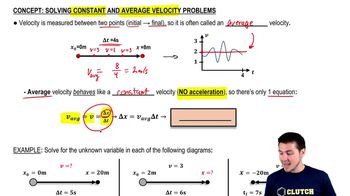
Average velocity is defined as the total displacement divided by the total time taken. It is a vector quantity, meaning it has both magnitude and direction. To find the average velocity, calculate the change in position over the given time interval and divide by the duration of that interval.
Video consigliato:
Percorso guidato
05:44
Solving Constant and Average Velocity Problems

Vector Components

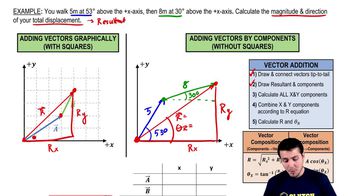
Vectors have components that describe their influence in different directions, typically represented by î, ĵ, and k̂ for the x, y, and z axes respectively. In this problem, the position vector r→ is given in terms of its î and ĵ components, which need to be analyzed separately to determine the overall displacement and velocity.
Video consigliato:
Percorso guidato
07:30
Vector Addition By Components

Magnitude and Direction of a Vector

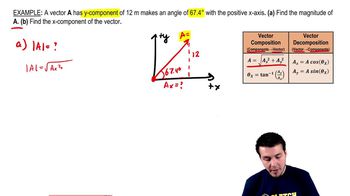
The magnitude of a vector is its length, calculated using the Pythagorean theorem for its components. The direction is given by the angle it makes with a reference axis, often found using trigonometric functions like tangent. For the average velocity, compute the magnitude from its components and use inverse tangent to find the direction.
Video consigliato:
Percorso guidato
03:59
Calculating Magnitude & Components of a Vector