
Ch 04: Newton's Laws of Motion
Young & Freedman Calc - University Physics 14th Edition
Young & Freedman Calc14th EditionUniversity PhysicsISBN: 9780321973610Non è quello che usi tu?Cambia libro di testo
Capitolo 4, Problema 11a

A hockey puck with mass 0.1600.160 kg is at rest at the origin (x=0x = 0) on the horizontal, frictionless surface of the rink. At time t=0t = 0 a player applies a force of 0.2500.250 N to the puck, parallel to the xx-axis; she continues to apply this force until t=2.00t = 2.00 s. What are the position and speed of the puck at t=2.00t = 2.00 s?

Guida verificata passo dopo passo
1
Step 1: Identify the given values and relevant equations. The mass of the puck is 0.160 kg, the applied force is 0.250 N, and the time duration is 2.00 s. Since the surface is frictionless, Newton's second law applies: F=ma, where a is the acceleration.
Step 2: Calculate the acceleration of the puck using Newton's second law. Rearrange the equation to solve for acceleration: a=Fm. Substitute the values of F and m.
Step 3: Use the kinematic equation to find the velocity of the puck at t=2.00 s. The equation is v=v_i+at, where v_i is the initial velocity (0 m/s, since the puck starts at rest). Substitute the values of a and t.
Step 4: Use the kinematic equation to find the position of the puck at t=2.00 s. The equation is x=x_i+v_it+12at^2, where x_i is the initial position (0 m). Substitute the values of v_i, a, and t.
Step 5: Combine the results from Steps 3 and 4 to summarize the position and velocity of the puck at t=2.00 s. Ensure all units are consistent and verify the calculations conceptually.

Risposta video verificata per un problema simile:

Questa soluzione video è stata consigliata dai nostri tutor come utile per risolvere questo problema.
Durata del video:
7m

Concetti chiave

Ecco i concetti essenziali che devi comprendere per rispondere correttamente alla domanda.

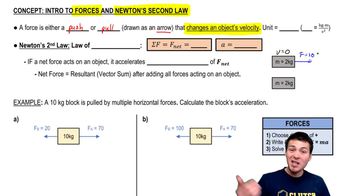
Newton's Second Law of Motion

Newton's Second Law states that the acceleration of an object is directly proportional to the net force acting on it and inversely proportional to its mass. This relationship is expressed by the formula F = ma, where F is the net force, m is the mass, and a is the acceleration. In this scenario, the applied force on the hockey puck will determine its acceleration, which is crucial for calculating its position and speed over time.
Video consigliato:
Percorso guidato
06:54
Intro to Forces & Newton's Second Law

Kinematic Equations

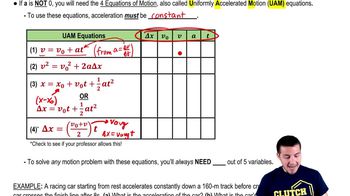
Kinematic equations describe the motion of objects under constant acceleration. They relate displacement, initial velocity, final velocity, acceleration, and time. For this problem, the relevant equations will help determine the puck's position and speed after 2 seconds, given its initial state of rest and the constant force applied.
Video consigliato:
Percorso guidato
08:25
Kinematics Equations

Uniform Acceleration

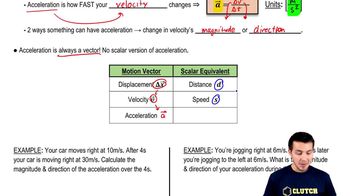
Uniform acceleration occurs when an object's velocity changes at a constant rate. In this case, the hockey puck experiences uniform acceleration due to the constant force applied by the player. Understanding this concept is essential for predicting how the puck's speed and position evolve over the 2-second interval, as it simplifies the calculations using the kinematic equations.
Video consigliato:
Percorso guidato
05:47
Intro to Acceleration
Pratica correlata
Domanda del libro di testo

A hockey puck with mass 0.1600.160 kg is at rest at the origin (x=0x = 0) on the horizontal, frictionless surface of the rink. At time t=0t = 0 a player applies a force of 0.2500.250 N to the puck, parallel to the xx-axis; she continues to apply this force until t=2.00t = 2.00 s. If the same force is again applied at t=5.00t = 5.00 s, what are the position and speed of the puck at t=7.00t = 7.00 s?

3226
views
Domanda del libro di testo

A box rests on a frozen pond, which serves as a frictionless horizontal surface. If a fisherman applies a horizontal force with magnitude 48.048.0 N to the box and produces an acceleration of magnitude 2.202.20 m/s2, what is the mass of the box?

2271
views
Domanda del libro di testo

A 4.504.50-kg experimental cart undergoes an acceleration in a straight line (the xx-axis). The graph in Fig. E4.134.13 shows this acceleration as a function of time. During what times is the net force on the cart a constant?

1784
views
Domanda del libro di testo

A dockworker applies a constant horizontal force of 80.080.0 N to a block of ice on a smooth horizontal floor. The frictional force is negligible. The block starts from rest and moves 11.011.0 m in 5.00 5.00 s. What is the mass of the block of ice?

2250
views
Domanda del libro di testo

A 4.504.50-kg experimental cart undergoes an acceleration in a straight line (the xx-axis). The graph in Fig. E4.134.13 shows this acceleration as a function of time. Find the maximum net force on this cart. When does this maximum force occur?

3283
views
Domanda del libro di testo

You walk into an elevator, step onto a scale, and push the 'up' button. You recall that your normal weight is 625625 N. Draw a free-body diagram. If you hold a 3.853.85-kg package by a light vertical string, what will be the tension in this string when the elevator accelerates as in part (a)? Note: Part (a) asked what does the scale read when the elevator has an upward acceleration of magnitude 2.502.50 m/s2.

3525
views
1
rank