Ch 04: Newton's Laws of Motion
Young & Freedman Calc - University Physics 14th Edition
Young & Freedman Calc14th EditionUniversity PhysicsISBN: 9780321973610Non è quello che usi tu?Cambia libro di testo
Capitolo 4, Problema 21

World-class sprinters can accelerate out of the starting blocks with an acceleration that is nearly horizontal and has magnitude 1515 m/s2. How much horizontal force must a 55 55-kg sprinter exert on the starting blocks to produce this acceleration? Which body exerts the force that propels the sprinter: the blocks or the sprinter herself?

Guida verificata passo dopo passo
1
Step 1: Begin by identifying the relationship between force, mass, and acceleration using Newton's Second Law of Motion, which is expressed as F=ma. Here, F is the force, m is the mass, and a is the acceleration.
Step 2: Substitute the given values into the formula. The mass of the sprinter is 55 kg, and the acceleration is 15 m/s2. The equation becomes F=55×15.
Step 3: Perform the multiplication to calculate the force. This will give the horizontal force exerted by the sprinter on the starting blocks.
Step 4: Address the second part of the question: The force that propels the sprinter forward is exerted by the starting blocks. According to Newton's Third Law of Motion, for every action, there is an equal and opposite reaction. The sprinter pushes against the blocks, and the blocks push back with an equal and opposite force, propelling the sprinter forward.
Step 5: Conclude by emphasizing the importance of understanding Newton's laws in analyzing motion and forces. The sprinter's ability to accelerate depends on the reaction force provided by the blocks, which is a direct consequence of the sprinter's action force.

Risposta video verificata per un problema simile:

Questa soluzione video è stata consigliata dai nostri tutor come utile per risolvere questo problema.
Durata del video:
2m

Concetti chiave

Ecco i concetti essenziali che devi comprendere per rispondere correttamente alla domanda.

Newton's Second Law of Motion

Newton's Second Law states that the force acting on an object is equal to the mass of that object multiplied by its acceleration (F = ma). This principle is crucial for understanding how the sprinter's mass and the desired acceleration relate to the force she must exert on the starting blocks.
Video consigliato:
Percorso guidato
06:54
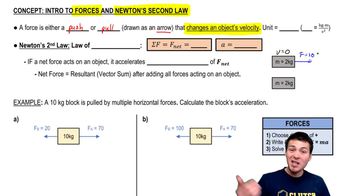
Intro to Forces & Newton's Second Law

Friction and Force Interaction

Friction is the force that opposes the relative motion of two surfaces in contact. In this scenario, the sprinter exerts a force against the blocks, and the friction between her shoes and the blocks allows her to accelerate. The interaction between these forces determines how effectively she can push off the blocks.
Video consigliato:
Percorso guidato
08:11
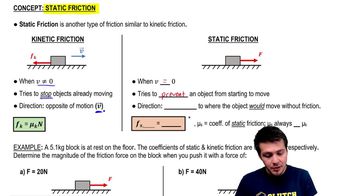
Static Friction & Equilibrium

Action and Reaction Forces

According to Newton's Third Law, for every action, there is an equal and opposite reaction. When the sprinter pushes against the starting blocks, she exerts a force on them, and in response, the blocks exert an equal force back on her. This reaction force is what propels her forward.
Video consigliato:
Percorso guidato
08:01
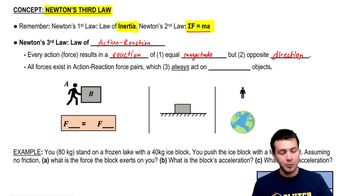
Newton's Third Law & Action-Reaction Pairs
Pratica correlata
Domanda del libro di testo

At the surface of Jupiter's moon Io, the acceleration due to gravity is g=1.81g = 1.81 m/s2. A watermelon weighs 44.044.0 N at the surface of the earth. What is the watermelon's mass on the earth's surface?

2391
views

Domanda del libro di testo

A ball is hanging from a long string that is tied to the ceiling of a train car traveling eastward on horizontal tracks. An observer inside the train car sees the ball hang motionless. Draw a clearly labeled free-body diagram for the ball if the train is speeding up uniformly. Is the net force on the ball zero in either case? Explain.

4007
views
2
rank
Domanda del libro di testo

A small car of mass 380380 kg is pushing a large truck of mass 900900 kg due east on a level road. The car exerts a horizontal force of 16001600 N on the truck. What is the magnitude of the force that the truck exerts on the car?

4747
views
Domanda del libro di testo

At the surface of Jupiter's moon Io, the acceleration due to gravity is g=1.81g = 1.81 m/s2. A watermelon weighs 44.044.0 N at the surface of the earth. What would be its mass and weight on the surface of Io?

5445
views
Domanda del libro di testo

Crates AA and BB sit at rest side by side on a frictionless horizontal surface. They have masses mAm_{A} and mBm_B, respectively. When a horizontal force FF is applied to crate AA, the two crates move off to the right. Draw clearly labeled free-body diagrams for crate AA and for crate BB. Indicate which pairs of forces, if any, are third-law action–reaction pairs.

2822
views
1
rank
Domanda del libro di testo

Boxes AA and BB are in contact on a horizontal, frictionless surface (Fig. E4.234.23). Box AA has mass 20.020.0 kg and box BB has mass 5.05.0 kg. A horizontal force of 250250 N is exerted on box AA. What is the magnitude of the force that box AA exerts on box BB?

9021
views
4
rank