Ch 06: Work & Kinetic Energy
Young & Freedman Calc - University Physics 14th Edition
Young & Freedman Calc14th EditionUniversity PhysicsISBN: 9780321973610Non è quello che usi tu?Cambia libro di testo
Capitolo 6, Problema 54

A 20.020.0-kg rock is sliding on a rough, horizontal surface at 8.008.00 m/s and eventually stops due to friction. The coefficient of kinetic friction between the rock and the surface is 0.2000.200. What average power is produced by friction as the rock stops?

Guida verificata passo dopo passo
1
Step 1: Identify the forces acting on the rock. The force of kinetic friction is given by \( F_{\text{friction}} = \mu_k \cdot F_{\text{normal}} \), where \( \mu_k \) is the coefficient of kinetic friction and \( F_{\text{normal}} \) is the normal force. Since the surface is horizontal, \( F_{\text{normal}} = m \cdot g \), where \( m \) is the mass of the rock and \( g \) is the acceleration due to gravity.
Step 2: Calculate the work done by friction. Work is defined as \( W = F_{\text{friction}} \cdot d \), where \( d \) is the distance over which the force acts. To find \( d \), use the kinematic equation \( v^2 = u^2 + 2a \cdot d \), where \( v \) is the final velocity (0 m/s), \( u \) is the initial velocity (8.00 m/s), and \( a \) is the acceleration caused by friction. The acceleration can be found using \( a = \frac{F_{\text{friction}}}{m} \).
Step 3: Determine the time it takes for the rock to stop. Use the kinematic equation \( v = u + a \cdot t \), where \( t \) is the time, \( v \) is the final velocity (0 m/s), \( u \) is the initial velocity (8.00 m/s), and \( a \) is the acceleration caused by friction.
Step 4: Calculate the average power produced by friction. Power is defined as \( P = \frac{W}{t} \), where \( W \) is the work done by friction and \( t \) is the time it takes for the rock to stop. Substitute the values of \( W \) and \( t \) obtained from the previous steps into this formula.
Step 5: Verify the units and ensure consistency. Work is measured in joules (\( J \)), time in seconds (\( s \)), and power in watts (\( W \)). Confirm that all calculations align with these units and the physical principles involved.

Risposta video verificata per un problema simile:

Questa soluzione video è stata consigliata dai nostri tutor come utile per risolvere questo problema.
Durata del video:
3m

Concetti chiave

Ecco i concetti essenziali che devi comprendere per rispondere correttamente alla domanda.

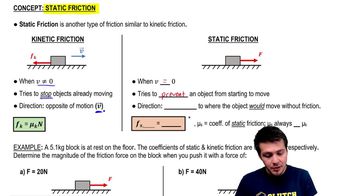
Friction

Friction is a force that opposes the relative motion of two surfaces in contact. In this scenario, kinetic friction acts on the rock as it slides, causing it to decelerate and eventually stop. The magnitude of kinetic friction can be calculated using the formula F_friction = μ_k * N, where μ_k is the coefficient of kinetic friction and N is the normal force.
Video consigliato:
Percorso guidato
08:11
Static Friction & Equilibrium

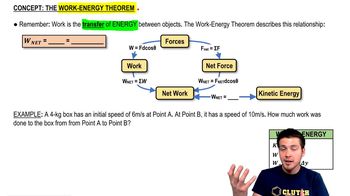
Work-Energy Principle

The work-energy principle states that the work done by all forces acting on an object equals the change in its kinetic energy. As the rock slides to a stop, the work done by friction is equal to the initial kinetic energy of the rock, which can be calculated using KE = 0.5 * m * v^2, where m is mass and v is velocity.
Video consigliato:
Percorso guidato
04:10
The Work-Energy Theorem

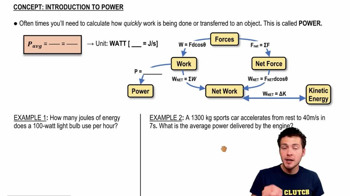
Power

Power is defined as the rate at which work is done or energy is transferred over time. It can be calculated using the formula P = W/t, where W is work and t is time. In this context, the average power produced by friction can be determined by dividing the work done by friction (which equals the initial kinetic energy of the rock) by the time it takes for the rock to come to a stop.
Video consigliato: