
To protect their young in the nest, peregrine falcons will fly into birds of prey (such as ravens) at high speed. In one such episode, a 600-g falcon flying at 20.0 m/s hit a 1.50-kg raven flying at 9.0 m/s. The falcon hit the raven at right angles to its original path and bounced back at 5.0 m/s. (These figures were estimated by the author as he watched this attack occur in northern New Mexico.) By what angle did the falcon change the raven's direction of motion?
Young & Freedman Calc 14th Edition
Ch 08: Momentum, Impulse, and Collisions
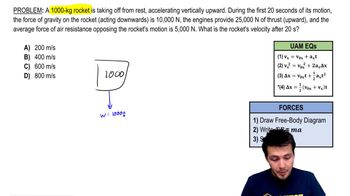
Problema 62aA small rocket burns 0.0500 kg of fuel per second, ejecting it as a gas with a velocity relative to the rocket of magnitude 1600 m/s. What is the thrust of the rocket?
Guida verificata passo dopo passo
Risposta video verificata per un problema simile:
Concetti chiave
Thrust
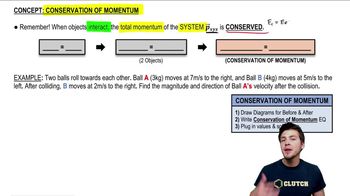
Conservation of Momentum
Mass Flow Rate
To protect their young in the nest, peregrine falcons will fly into birds of prey (such as ravens) at high speed. In one such episode, a 600-g falcon flying at 20.0 m/s hit a 1.50-kg raven flying at 9.0 m/s. The falcon hit the raven at right angles to its original path and bounced back at 5.0 m/s. (These figures were estimated by the author as he watched this attack occur in northern New Mexico.) What was the raven's speed right after the collision?
Jack (mass 55.0 kg) is sliding due east with speed 8.00 m/s on the surface of a frozen pond. He collides with Jill (mass 48.0 kg), who is initially at rest. After the collision, Jack is traveling at 5.00 m/s in a direction 34.0° north of east. What is Jill's velocity (magnitude and direction) after the collision? Ignore friction.