
Ch 09: Rotation of Rigid Bodies
Young & Freedman Calc - University Physics 14th Edition
Young & Freedman Calc14th EditionUniversity PhysicsISBN: 9780321973610Non è quello che usi tu?Cambia libro di testo
Capitolo 9, Problema 21b

A wheel of diameter 40.0 cm starts from rest and rotates with a constant angular acceleration of 3.00 rad/s2. Compute the radial acceleration of a point on the rim for the instant the wheel completes its second revolution from the relationship arad = v2/r.

Guida verificata passo dopo passo
1
Step 1: Start by determining the angular displacement (θ) for two revolutions. Since one revolution corresponds to an angular displacement of 2π radians, two revolutions correspond to θ = 4π radians.
Step 2: Use the kinematic equation for rotational motion to find the angular velocity (ω) at the instant the wheel completes its second revolution. The equation is: ω^2 = ω_0^2 + 2αθ, where ω_0 is the initial angular velocity (0 rad/s), α is the angular acceleration (3.00 rad/s²), and θ is the angular displacement (4π radians).
Step 3: Calculate the linear velocity (v) of a point on the rim of the wheel using the relationship between linear and angular velocity: v = rω, where r is the radius of the wheel. The radius can be found from the diameter: r = 40.0 cm / 2 = 20.0 cm = 0.200 m.
Step 4: Substitute the value of v into the formula for radial acceleration: a_{rad} = \(\frac{v^2}{r}\). Use the radius (r = 0.200 m) and the linear velocity (v) calculated in the previous step.
Step 5: Simplify the expression to find the radial acceleration (a_rad). Ensure all units are consistent (meters, seconds, etc.) throughout the calculation.

Risposta video verificata per un problema simile:

Questa soluzione video è stata consigliata dai nostri tutor come utile per risolvere questo problema.
Durata del video:
3m

Concetti chiave

Ecco i concetti essenziali che devi comprendere per rispondere correttamente alla domanda.

Angular Acceleration

Angular acceleration is the rate of change of angular velocity over time, typically measured in radians per second squared (rad/s²). In this scenario, the wheel has a constant angular acceleration of 3.00 rad/s², which means its angular velocity increases uniformly as it rotates. This concept is crucial for determining the wheel's angular velocity at any given time.
Video consigliato:
Percorso guidato
12:12
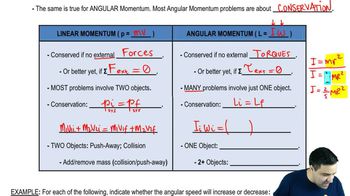
Conservation of Angular Momentum

Tangential Velocity

Tangential velocity is the linear speed of a point on the circumference of a rotating object, calculated as the product of the radius and the angular velocity (v = rω). As the wheel rotates, its tangential velocity increases due to the constant angular acceleration. This velocity is essential for calculating the radial acceleration at a specific point on the wheel.
Video consigliato:
Percorso guidato
05:53
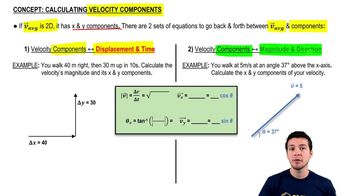
Calculating Velocity Components

Radial (Centripetal) Acceleration

Radial acceleration, also known as centripetal acceleration, is the acceleration directed towards the center of a circular path, necessary for an object to maintain its circular motion. It can be calculated using the formula a_rad = v²/r, where v is the tangential velocity and r is the radius of the circular path. Understanding this concept is vital for solving the problem regarding the acceleration of a point on the wheel's rim.
Video consigliato:
Percorso guidato
06:48
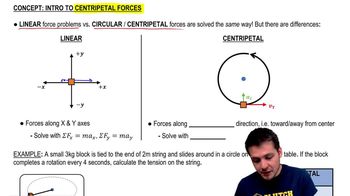
Intro to Centripetal Forces
Pratica correlata
Domanda del libro di testo

CA compact disc (CD) stores music in a coded pattern of tiny pits 10-7 m deep. The pits are arranged in a track that spirals outward toward the rim of the disc; the inner and outer radii of this spiral are 25.0 mm and 58.0 mm, respectively. As the disc spins inside a CD player, the track is scanned at a constant linear speed of 1.25 m/s. The maximum playing time of a CD is 74.0 min. What would be the length of the track on such a maximum-duration CD if it were stretched out in a straight line?

2439
views
Domanda del libro di testo

An electric turntable 0.750 m in diameter is rotating about a fixed axis with an initial angular velocity of 0.250 rev/s and a constant angular acceleration of 0.900 rev/s2.

(a) Compute the angular velocity of the turntable after 0.200 s.

(b) Through how many revolutions has the turntable spun in this time interval?

2138
views
Domanda del libro di testo

A compact disc (CD) stores music in a coded pattern of tiny pits 10-7 m deep. The pits are arranged in a track that spirals outward toward the rim of the disc; the inner and outer radii of this spiral are 25.0 mm and 58.0 mm, respectively. As the disc spins inside a CD player, the track is scanned at a constant linear speed of 1.25 m/s. What is the average angular acceleration of a maximum duration CD during its 74.0-min playing time? Take the direction of rotation of the disc to be positive.

1739
views
Domanda del libro di testo

A wheel of diameter 40.0 cm starts from rest and rotates with a constant angular acceleration of 3.00 rad/s2. Compute the radial acceleration of a point on the rim for the instant the wheel completes its second revolution from the relationship arad = ω2r.

2019
views
Domanda del libro di testo

An electric turntable 0.750 m in diameter is rotating about a fixed axis with an initial angular velocity of 0.250 rev/s and a constant angular acceleration of 0.900 rev/s2. What is the tangential speed of a point on the rim of the turntable at t = 0.200 s?

3157
views
1
comments
Domanda del libro di testo

An electric turntable 0.750 m in diameter is rotating about a fixed axis with an initial angular velocity of 0.250 rev/s and a constant angular acceleration of 0.900 rev/s2. What is the magnitude of the resultant acceleration of a point on the rim at t = 0.200 s?

126
views