A fan blade rotates with angular velocity given by ωz(t) = g - bt2, where g = 5.00 rad/s and b = 0.800 rad/s3. Calculate the angular acceleration as a function of time.
Ch 09: Rotation of Rigid Bodies
Young & Freedman Calc14th EditionUniversity PhysicsISBN: 9780321973610Non è quello che usi tu?Cambia libro di testo
Capitolo 9, Problema 3b
The angular velocity of a flywheel obeys the equation ωz(t) = A + Bt2, where t is in seconds and A and B are constants having numerical values 2.75 (for A) and 1.50 (for B). What is the angular acceleration of the wheel at (i) t = 0 and (ii) t = 5.00 s?
Guida verificata passo dopo passo1
Understand the problem: The angular velocity of the flywheel is given as a function of time, \( \omega_z(t) = A + B t^2 \), where \( A = 2.75 \) and \( B = 1.50 \). Angular acceleration is the time derivative of angular velocity, \( \alpha(t) = \frac{d\omega_z(t)}{dt} \). We need to calculate \( \alpha(t) \) at \( t = 0 \) and \( t = 5.00 \ \text{s} \).
Differentiate the angular velocity equation with respect to time to find the angular acceleration: \( \alpha(t) = \frac{d}{dt}(A + B t^2) \). Since \( A \) is a constant, its derivative is zero, and the derivative of \( B t^2 \) is \( 2 B t \). Thus, \( \alpha(t) = 2 B t \).
Substitute the value of \( B = 1.50 \) into the angular acceleration equation: \( \alpha(t) = 2 (1.50) t = 3.00 t \). This is the expression for angular acceleration as a function of time.
To find the angular acceleration at \( t = 0 \), substitute \( t = 0 \) into \( \alpha(t) = 3.00 t \): \( \alpha(0) = 3.00 (0) \). Simplify to find the angular acceleration at \( t = 0 \).
To find the angular acceleration at \( t = 5.00 \ \text{s} \), substitute \( t = 5.00 \) into \( \alpha(t) = 3.00 t \): \( \alpha(5.00) = 3.00 (5.00) \). Simplify to find the angular acceleration at \( t = 5.00 \ \text{s} \).

Risposta video verificata per un problema simile:
Questa soluzione video è stata consigliata dai nostri tutor come utile per risolvere questo problema.
Durata del video:
2mConcetti chiave
Ecco i concetti essenziali che devi comprendere per rispondere correttamente alla domanda.
Angular Velocity
Angular velocity is a measure of how quickly an object rotates around an axis, typically expressed in radians per second. In the given equation, ω_z(t) = A + Bt², the angular velocity depends on time and is influenced by constants A and B. Understanding this concept is crucial for analyzing rotational motion and determining how the speed of rotation changes over time.
Video consigliato:
Percorso guidato
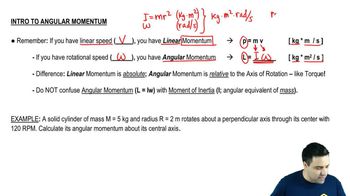
Intro to Angular Momentum
Angular Acceleration
Angular acceleration refers to the rate of change of angular velocity over time, usually expressed in radians per second squared. It can be calculated as the derivative of angular velocity with respect to time. In this case, to find the angular acceleration, we differentiate the given equation for angular velocity, which will provide insights into how the rotation speed of the flywheel changes at specific moments.
Video consigliato:
Percorso guidato
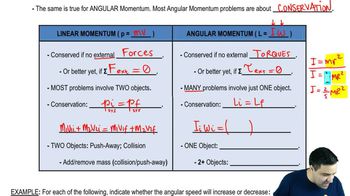
Conservation of Angular Momentum
Differentiation in Physics
Differentiation is a fundamental mathematical process used in physics to determine rates of change. In the context of the problem, differentiating the angular velocity function with respect to time allows us to find the angular acceleration. This concept is essential for analyzing dynamic systems, as it helps relate position, velocity, and acceleration in both linear and rotational motion.
Video consigliato:
Percorso guidato
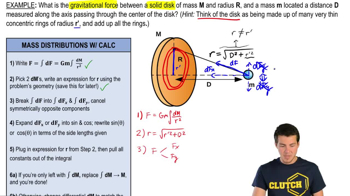
Gravitational Force from a Solid Disk
Pratica correlata
Domanda del libro di testo
1766
views
Domanda del libro di testo
A fan blade rotates with angular velocity given by ωz(t) = g - bt2, where g = 5.00 rad/s and b = 0.800 rad/s3. Calculate the instantaneous angular acceleration αz at t = 3.00 s and the average angular acceleration αav-z for the time interval t = 0 to t = 3.00 s. How do these two quantities compare? If they are different, why?
2133
views
Domanda del libro di testo
The angle θ through which a disk drive turns is given by θ(t) = a + bt - ct3, where a, b, and c are constants, t is in seconds, and θ is in radians. When t = 0, θ = π/4 rad and the angular velocity is 2.00 rad/s. When t = 1.50 s, the angular acceleration is 1.25 rad/s2. Find a, b, and c, including their units.
1733
views