
Ch 10: Dynamics of Rotational Motion
Young & Freedman Calc - University Physics 14th Edition
Young & Freedman Calc14th EditionUniversity PhysicsISBN: 9780321973610Non è quello che usi tu?Cambia libro di testo
Capitolo 10, Problema 46

Suppose that an asteroid traveling straight toward the center of the earth were to collide with our planet at the equator and bury itself just below the surface. What would have to be the mass of this asteroid, in terms of the earth's mass M, for the day to become 25.0% longer than it presently is as a result of the collision? Assume that the asteroid is very small compared to the earth and that the earth is uniform throughout.

Guida verificata passo dopo passo
1
Understand the problem: We need to find the mass of the asteroid that would cause the Earth's rotation period to increase by 25%. This involves the conservation of angular momentum, as the collision is inelastic and the asteroid embeds itself into the Earth.
Identify the initial and final states: Initially, the Earth is rotating with an angular velocity \( \omega_i \) and has a moment of inertia \( I_i = \frac{2}{5}MR^2 \), where \( M \) is the Earth's mass and \( R \) is its radius. After the collision, the new angular velocity is \( \omega_f \) and the moment of inertia becomes \( I_f = \frac{2}{5}MR^2 + mR^2 \), where \( m \) is the mass of the asteroid.
Apply the conservation of angular momentum: The initial angular momentum \( L_i = I_i \omega_i \) must equal the final angular momentum \( L_f = I_f \omega_f \). Therefore, \( \frac{2}{5}MR^2 \omega_i = \left( \frac{2}{5}MR^2 + mR^2 \right) \omega_f \).
Relate the change in the Earth's rotation period: The period of rotation \( T \) is inversely proportional to the angular velocity, so \( T_f = 1.25T_i \) implies \( \omega_f = \frac{\omega_i}{1.25} \). Substitute this into the angular momentum equation.
Solve for the mass of the asteroid \( m \): Rearrange the equation from step 3 to solve for \( m \) in terms of \( M \). This will give you the mass of the asteroid needed to increase the Earth's day by 25%.

Risposta video verificata per un problema simile:

Questa soluzione video è stata consigliata dai nostri tutor come utile per risolvere questo problema.
Durata del video:
11m

Concetti chiave

Ecco i concetti essenziali che devi comprendere per rispondere correttamente alla domanda.

Conservation of Angular Momentum

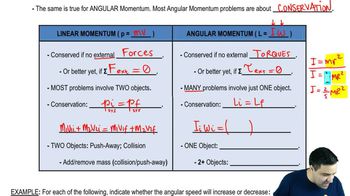
The conservation of angular momentum states that if no external torques act on a system, the total angular momentum remains constant. In this scenario, the earth-asteroid system's angular momentum before and after the collision must be equal, allowing us to relate the asteroid's mass to the change in the earth's rotational period.
Video consigliato:
Percorso guidato
12:12
Conservation of Angular Momentum

Moment of Inertia

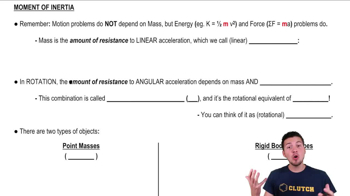
Moment of inertia is a measure of an object's resistance to changes in its rotation. For a uniform sphere like the earth, it is calculated as I = (2/5)MR², where M is the mass and R is the radius. Understanding how the asteroid's mass affects the earth's moment of inertia is crucial for determining the change in rotational speed.
Video consigliato:
Percorso guidato
11:47
Intro to Moment of Inertia

Rotational Kinematics

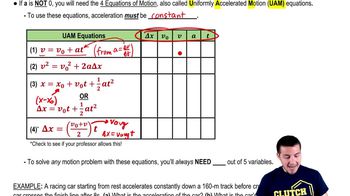
Rotational kinematics involves the study of rotational motion without considering the forces that cause it. The earth's rotational period is related to its angular velocity, and a change in this period due to the collision can be analyzed using the relationship between angular velocity and moment of inertia, helping to find the asteroid's required mass.
Video consigliato:
Percorso guidato
08:25
Kinematics Equations
Pratica correlata
Domanda del libro di testo

A solid wood door 1.00 m wide and 2.00 m high is hinged along one side and has a total mass of 40.0 kg. Initially open and at rest, the door is struck at its center by a handful of sticky mud with mass 0.500 kg, traveling perpendicular to the door at 12.0 m/s just before impact. Find the final angular speed of the door. Does the mud make a significant contribution to the moment of inertia?

3415
views
Domanda del libro di testo

A thin uniform rod has a length of 0.500 m0.500\(\text{ m}\) and is rotating in a circle on a frictionless table. The axis of rotation is perpendicular to the length of the rod at one end and is stationary. The rod has an angular velocity of 0.400 rad/s0.400\(\text{ rad/s}\) and a moment of inertia about the axis of 3.00×10⁻³kg/m23.00\(\times\)10^{-3}\(\text{kg/m}\)^2. A bug initially standing on the rod at the axis of rotation decides to crawl out to the other end of the rod. When the bug has reached the end of the rod and sits there, its tangential speed is 0.160 m/s0.160\(\text{ m/s}\). The bug can be treated as a point mass. What is the mass of the rod.

3866
views
1
comments
Domanda del libro di testo

A uniform, 4.5-kg, square, solid wooden gate 1.5 m on each side hangs vertically from a frictionless pivot at the center of its upper edge. A 1.1-kg raven flying horizontally at 5.0 m/s flies into this door at its center and bounces back at 2.0 m/s in the opposite direction. What is the angular speed of the gate just after it is struck by the unfortunate raven?

2418
views
Domanda del libro di testo

A large wooden turntable in the shape of a flat uniform disk has a radius of 2.00 m and a total mass of 120 kg. The turntable is initially rotating at 3.00 rad/s about a vertical axis through its center. Suddenly, a 70.0-kg parachutist makes a soft landing on the turntable at a point near the outer edge. Compute the kinetic energy of the system before and after the parachutist lands. Why are these kinetic energies not equal?

2567
views
Domanda del libro di testo

A small 10.0-g bug stands at one end of a thin uniform bar that is initially at rest on a smooth horizontal table. The other end of the bar pivots about a nail driven into the table and can rotate freely, without friction. The bar has mass 50.0 g and is 100 cm in length. The bug jumps off in the horizontal direction, perpendicular to the bar, with a speed of 20.0 cm/s relative to the table. What is the angular speed of the bar just after the frisky insect leaps?

1715
views
Domanda del libro di testo

A large wooden turntable in the shape of a flat uniform disk has a radius of 2.00 m and a total mass of 120 kg. The turntable is initially rotating at 3.00 rad/s about a vertical axis through its center. Suddenly, a 70.0-kg parachutist makes a soft landing on the turntable at a point near the outer edge. Find the angular speed of the turntable after the parachutist lands. (Assume that you can treat the parachutist as a particle.)

1785
views