Ch 10: Dynamics of Rotational Motion
Young & Freedman Calc - University Physics 14th Edition
Young & Freedman Calc14th EditionUniversity PhysicsISBN: 9780321973610Non è quello che usi tu?Cambia libro di testo
Capitolo 10, Problema 1a

Calculate the torque (magnitude and direction) about point O due to the force F in each of the cases sketched in Fig. E10.1. In each case, both the force F and the rod lie in the plane of the page, the rod has length 4.00 m, and the force has magnitude F = 10.0 N.

Guida verificata passo dopo passo
1
Identify the given values: The length of the rod (r) is 4.00 m, the magnitude of the force (F) is 10.0 N, and the angle between the force and the rod is 90 degrees.
Recall the formula for torque (τ), which is given by τ = r * F * sin(θ), where θ is the angle between the force and the lever arm.
Substitute the given values into the torque formula: τ = 4.00 m * 10.0 N * sin(90°).
Since sin(90°) is 1, the torque simplifies to τ = 4.00 m * 10.0 N * 1.
Determine the direction of the torque: Since the force is applied perpendicular to the rod and in the upward direction, the torque will cause a counterclockwise rotation about point O.

Risposta video verificata per un problema simile:

Questa soluzione video è stata consigliata dai nostri tutor come utile per risolvere questo problema.
Durata del video:
1m

Concetti chiave

Ecco i concetti essenziali che devi comprendere per rispondere correttamente alla domanda.

Torque

Torque is a measure of the rotational force applied to an object around a pivot point. It is calculated as the product of the force magnitude and the perpendicular distance from the pivot to the line of action of the force. The direction of torque is determined by the right-hand rule, which indicates whether the rotation is clockwise or counterclockwise.
Video consigliato:
Percorso guidato
08:55
Net Torque & Sign of Torque

Lever Arm

The lever arm is the perpendicular distance from the pivot point to the line of action of the force. It is crucial in determining the torque, as torque is directly proportional to this distance. In the given problem, the lever arm is 3 meters, which is the distance from the pivot to where the force is applied.
Video consigliato:
Percorso guidato
06:58
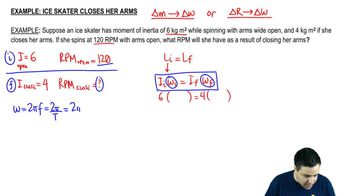
Ice skater closes her arms

Right-Hand Rule

The right-hand rule is a mnemonic used to determine the direction of the torque vector. To apply it, point your thumb in the direction of the axis of rotation, and curl your fingers in the direction of the force. The direction your thumb points indicates the direction of the torque. In this scenario, the force applied downward results in a clockwise torque about the pivot.
Video consigliato:
Percorso guidato
19:11
Force on Moving Charges & Right Hand Rule