
Ch 12: Fluid Mechanics
Young & Freedman Calc - University Physics 14th Edition
Young & Freedman Calc14th EditionUniversity PhysicsISBN: 9780321973610Non è quello che usi tu?Cambia libro di testo
Capitolo 12, Problema 32ab

A hollow plastic sphere is held below the surface of a freshwater lake by a cord anchored to the bottom of the lake. The sphere has a volume of 0.650 m3 and the tension in the cord is 1120 N. (a) Calculate the buoyant force exerted by the water on the sphere. (b) What is the mass of the sphere?

Guida verificata passo dopo passo
1
To calculate the buoyant force exerted by the water on the sphere, use Archimedes' principle, which states that the buoyant force is equal to the weight of the fluid displaced by the object. The formula for buoyant force \( F_b \) is: \( F_b = \rho_{water} \times V \times g \), where \( \rho_{water} \) is the density of water (approximately 1000 kg/m^3), \( V \) is the volume of the sphere (0.650 m^3), and \( g \) is the acceleration due to gravity (approximately 9.81 m/s^2).
Substitute the known values into the buoyant force formula: \( F_b = 1000 \times 0.650 \times 9.81 \). This will give you the buoyant force in newtons.
To find the mass of the sphere, consider the forces acting on it. The sphere is in equilibrium, so the sum of the forces is zero. The forces are the buoyant force \( F_b \), the tension in the cord \( T \), and the weight of the sphere \( W = m \times g \). The equation is: \( F_b = T + m \times g \).
Rearrange the equation to solve for the mass \( m \) of the sphere: \( m = \frac{F_b - T}{g} \).
Substitute the values for \( F_b \) (calculated in step 2), \( T = 1120 \) N, and \( g = 9.81 \) m/s^2 into the equation to find the mass of the sphere.

Risposta video verificata per un problema simile:

Questa soluzione video è stata consigliata dai nostri tutor come utile per risolvere questo problema.
Durata del video:
5m

Concetti chiave

Ecco i concetti essenziali che devi comprendere per rispondere correttamente alla domanda.

Buoyant Force

The buoyant force is the upward force exerted by a fluid on an object submerged in it. According to Archimedes' principle, this force is equal to the weight of the fluid displaced by the object. For the sphere in the lake, the buoyant force can be calculated using the volume of the sphere and the density of the water.
Video consigliato:
Percorso guidato
03:14
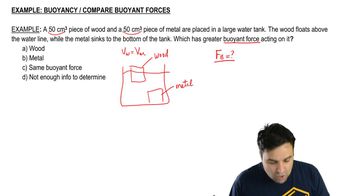
Comparing Buoyant Forces

Density and Volume Relationship

Density is defined as mass per unit volume. In this context, the density of water is crucial for determining the buoyant force. The volume of the sphere is given, and by knowing the density of freshwater (approximately 1000 kg/m^3), we can calculate the weight of the water displaced, which is essential for finding the buoyant force.
Video consigliato:
Percorso guidato
04:33
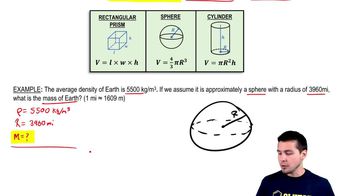
Problems with Mass, Volume, & Density

Equilibrium of Forces

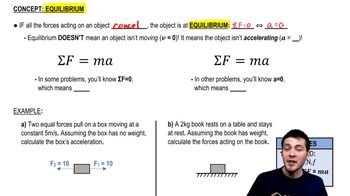
When the sphere is submerged and held by a cord, it is in equilibrium, meaning the net force acting on it is zero. The forces involved are the buoyant force, the tension in the cord, and the gravitational force on the sphere. Understanding this balance allows us to solve for unknowns, such as the mass of the sphere, by setting the sum of forces to zero.
Video consigliato:
Pratica correlata
Domanda del libro di testo

A hollow plastic sphere is held below the surface of a freshwater lake by a cord anchored to the bottom of the lake. The sphere has a volume of 0.650 m3 and the tension in the cord is 1120 N. The cord breaks and the sphere rises to the surface. When the sphere comes to rest, what fraction of its volume will be submerged?

1832
views
Domanda del libro di testo

An ore sample weighs 17.50 N in air. When the sample is suspended by a light cord and totally immersed in water, the tension in the cord is 11.20 N. Find the total volume and the density of the sample.

3221
views
Domanda del libro di testo

A cubical block of wood, 10.0 cm on a side, floats at the interface between oil and water with its lower surface 1.50 cm below the interface (Fig. E12.33). The density of the oil is 790 kg/m3. (a) What is the gauge pressure at the upper face of the block? (b) What is the gauge pressure at the lower face of the block?

3736
views
1
comments
Domanda del libro di testo

A slab of ice floats on a freshwater lake. What minimum volume must the slab have for a 65.0-kg woman to be able to stand on it without getting her feet wet?

2993
views
1
rank
Domanda del libro di testo

A cubical block of wood, 10.0 cm on a side, floats at the interface between oil and water with its lower surface 1.50 cm below the interface (Fig. E12.33). The density of the oil is 790 kg/m3. (a) What is the gauge pressure at the upper face of the block? (b) What is the gauge pressure at the lower face of the block?

2027
views
Domanda del libro di testo

A 950-kg cylindrical can buoy floats vertically in sea-water. The diameter of the buoy is 0.900 m. Calculate the additional distance the buoy will sink when an 80.0-kg man stands on top of it.

2786
views
1
rank