
Ch 13: Gravitation
Young & Freedman Calc - University Physics 14th Edition
Young & Freedman Calc14th EditionUniversity PhysicsISBN: 9780321973610Non è quello che usi tu?Cambia libro di testo
Capitolo 13, Problema 12a

The mass of Venus is 81.5% that of the earth, and its radius is 94.9% that of the earth. Compute the acceleration due to gravity on the surface of Venus from these data.

Guida verificata passo dopo passo
1
Start by recalling the formula for gravitational acceleration on the surface of a planet: \( g = \frac{G \cdot M}{R^2} \), where \( G \) is the gravitational constant, \( M \) is the mass of the planet, and \( R \) is the radius of the planet.
Express the mass of Venus \( M_v \) in terms of Earth's mass \( M_e \): \( M_v = 0.815 \cdot M_e \).
Express the radius of Venus \( R_v \) in terms of Earth's radius \( R_e \): \( R_v = 0.949 \cdot R_e \).
Substitute \( M_v \) and \( R_v \) into the gravitational acceleration formula for Venus: \( g_v = \frac{G \cdot (0.815 \cdot M_e)}{(0.949 \cdot R_e)^2} \).
Simplify the expression to find \( g_v \) in terms of Earth's gravitational acceleration \( g_e \), where \( g_e = \frac{G \cdot M_e}{R_e^2} \). This gives \( g_v = g_e \cdot \frac{0.815}{0.949^2} \).

Risposta video verificata per un problema simile:

Questa soluzione video è stata consigliata dai nostri tutor come utile per risolvere questo problema.
Durata del video:
3m

Concetti chiave

Ecco i concetti essenziali che devi comprendere per rispondere correttamente alla domanda.

Gravitational Acceleration

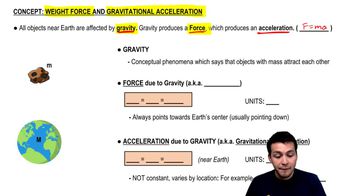
Gravitational acceleration is the acceleration of an object due to the force of gravity acting on it. It is calculated using the formula g = G * M / R^2, where G is the gravitational constant, M is the mass of the celestial body, and R is its radius. This formula helps determine how strong the gravitational pull is on the surface of a planet like Venus.
Video consigliato:
Percorso guidato
07:32
Weight Force & Gravitational Acceleration

Mass and Radius Proportions

Understanding the proportions of mass and radius between two celestial bodies is crucial for comparing their gravitational forces. In this context, Venus's mass is 81.5% of Earth's, and its radius is 94.9% of Earth's. These proportions allow us to adjust the gravitational formula to calculate Venus's surface gravity relative to Earth's known values.
Video consigliato:
Percorso guidato
2:39
Proportional Reasoning

Universal Gravitational Constant

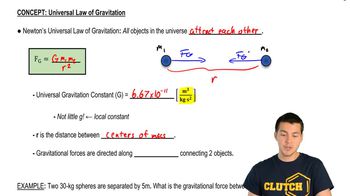
The universal gravitational constant (G) is a key factor in calculating gravitational forces. It is a constant value (approximately 6.674 × 10^-11 N m²/kg²) that appears in Newton's law of universal gravitation. This constant helps quantify the gravitational force between two masses and is essential for calculating the gravitational acceleration on any planet, including Venus.
Video consigliato:
Percorso guidato
04:05
Universal Law of Gravitation