
Ch 13: Gravitation
Young & Freedman Calc - University Physics 14th Edition
Young & Freedman Calc14th EditionUniversity PhysicsISBN: 9780321973610Non è quello che usi tu?Cambia libro di testo
Capitolo 13, Problema 5

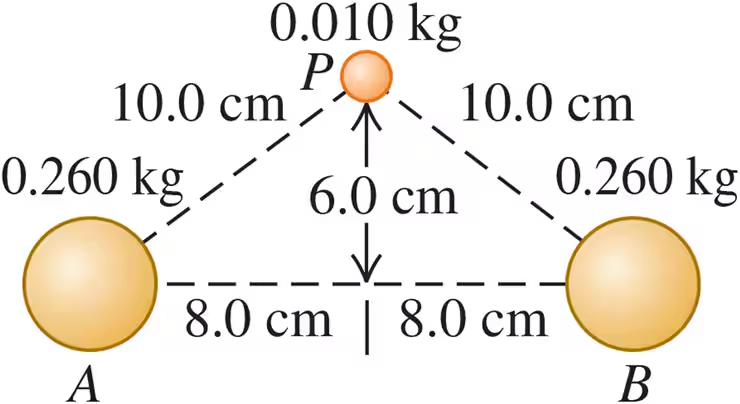
Two uniform spheres, each of mass 0.260 kg, are fixed at points A and B (Fig. E13.5). Find the magnitude and direction of the initial acceleration of a uniform sphere with mass 0.010 kg if released from rest at point P and acted on only by forces of gravitational attraction of the spheres at A and B.

Guida verificata passo dopo passo
1
Identify the forces acting on the sphere at point P due to the gravitational attraction from the spheres at points A and B. Use Newton's law of universal gravitation: F=GmMr2, where G is the gravitational constant, m and M are the masses of the spheres, and r is the distance between the spheres.
Calculate the gravitational force exerted by the sphere at point A on the sphere at point P. Use the formula: F=GmMr2, substituting the appropriate values for the masses and distance.
Calculate the gravitational force exerted by the sphere at point B on the sphere at point P using the same formula as in step 2, substituting the appropriate values for the masses and distance.
Determine the net gravitational force acting on the sphere at point P by vectorially adding the forces calculated in steps 2 and 3. Consider the direction of each force based on the positions of points A and B relative to point P.
Use Newton's second law of motion, F=ma, to find the magnitude and direction of the initial acceleration of the sphere at point P. Solve for a by dividing the net force by the mass of the sphere at point P.

Risposta video verificata per un problema simile:

Questa soluzione video è stata consigliata dai nostri tutor come utile per risolvere questo problema.
Durata del video:
13m

Concetti chiave

Ecco i concetti essenziali che devi comprendere per rispondere correttamente alla domanda.

Newton's Law of Universal Gravitation

Newton's Law of Universal Gravitation states that every point mass attracts every other point mass by a force acting along the line intersecting both points. The magnitude of the force is proportional to the product of the masses and inversely proportional to the square of the distance between them. This law is essential for calculating the gravitational forces exerted by the spheres at points A and B on the sphere at point P.
Video consigliato:
Percorso guidato
04:05
Universal Law of Gravitation

Superposition Principle

The Superposition Principle in physics states that the net force acting on an object is the vector sum of all individual forces acting on it. In this problem, the sphere at point P experiences gravitational forces from both spheres at points A and B, and the superposition principle allows us to calculate the resultant force by summing these individual forces vectorially.
Video consigliato:
Percorso guidato
03:32
Superposition of Sinusoidal Wave Functions

Newton's Second Law of Motion

Newton's Second Law of Motion states that the acceleration of an object is directly proportional to the net force acting on it and inversely proportional to its mass. This law is crucial for determining the initial acceleration of the sphere at point P once the net gravitational force is calculated, as it relates the force to the sphere's acceleration.
Video consigliato:
Percorso guidato
06:54
Intro to Forces & Newton's Second Law