Ch 15: Mechanical Waves
Young & Freedman Calc - University Physics 14th Edition
Young & Freedman Calc14th EditionUniversity PhysicsISBN: 9780321973610Non è quello che usi tu?Cambia libro di testo
Capitolo 15, Problema 28fg

A fellow student with a mathematical bent tells you that the wave function of a traveling wave on a thin rope is y(x,t)=(2.30mm)cos[(16.98 rad/m)x+(742 rad/s)t]y(x,t)=\(\left\)(2.30\(\operatorname{mm)}\)\(\cos\)[\(\left\)(16.98\(\text{ }\)rad/m\(\right\))x+(742\(\text{ }\)rad/s\(\right\))t]. Being more practical, you measure the rope to have a length of 1.35 m1.35\(\text{ m}\) and a mass of 0.00338kg0.00338\(\operatorname{kg}\). You are then asked to determine the following: (f) tension in the rope; (g) average power transmitted by the wave.

Guida verificata passo dopo passo
1
Step 1: Identify the wave function given in the problem: y(x, t) = 2.30 mm cos[(16.98 rad/m)x + (742 rad/s)t]. This function describes a traveling wave on a rope.
Step 2: Calculate the wave speed (v) using the wave number (k) and angular frequency (ω). The wave number k is 16.98 rad/m, and the angular frequency ω is 742 rad/s. Use the formula v = ω/k to find the wave speed.
Step 3: Determine the linear mass density (μ) of the rope. The linear mass density is the mass per unit length of the rope. Use the formula μ = mass/length, where the mass is 0.00338 kg and the length is 1.35 m.
Step 4: Calculate the tension (T) in the rope using the wave speed and linear mass density. The formula for tension is T = μv², where μ is the linear mass density and v is the wave speed calculated in Step 2.
Step 5: Calculate the average power (P) transmitted by the wave. Use the formula P = (1/2)μvω²A², where A is the amplitude of the wave (2.30 mm converted to meters), μ is the linear mass density, v is the wave speed, and ω is the angular frequency.

Risposta video verificata per un problema simile:

Questa soluzione video è stata consigliata dai nostri tutor come utile per risolvere questo problema.
Durata del video:
9m

Concetti chiave

Ecco i concetti essenziali che devi comprendere per rispondere correttamente alla domanda.

Wave Function

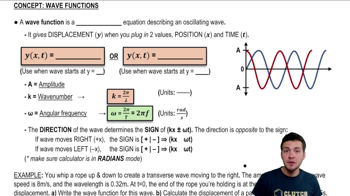
The wave function y(x, t) = 2.30mm cos[(16.98 rad/m)x + (742 rad/s)t] describes the displacement of a wave at position x and time t. It includes parameters like amplitude, wave number, and angular frequency, which are crucial for understanding wave behavior and calculating properties like speed and energy.
Video consigliato:
Percorso guidato
08:30
Intro to Wave Functions

Tension in the Rope

Tension in the rope is a force that affects wave propagation speed. It can be calculated using the formula v = sqrt(T/μ), where v is the wave speed, T is the tension, and μ is the linear mass density (mass per unit length). Understanding tension is essential for determining how fast waves travel along the rope.
Video consigliato:
Percorso guidato
06:34
Calculating Tension in a Pendulum with Energy Conservation

Average Power Transmitted by the Wave

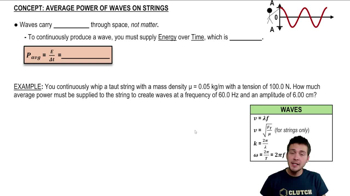
The average power transmitted by a wave is the rate at which energy is transferred along the medium. It can be calculated using P_avg = (1/2)μω^2A^2v, where μ is the linear mass density, ω is the angular frequency, A is the amplitude, and v is the wave speed. This concept helps in understanding the energy dynamics of wave motion.
Video consigliato:
Percorso guidato
04:39
Energy & Power of Waves on Strings
Pratica correlata
Domanda del libro di testo

Two pulses are moving in opposite directions at 1.0 cm/s on a taut string, as shown in Fig. E15.34. Each square is 1.0 cm.

<Image>

Sketch the shape of the string at the end of 6.0 s.

2169
views

Domanda del libro di testo

A fellow student with a mathematical bent tells you that the wave function of a traveling wave on a thin rope is y(x,t)=(2.30mm)cos[(16.98 rad/m)x+(742 rad/s)t]y(x,t)=\(\left\)(2.30\(\operatorname{mm)}\)\(\cos\)[\(\left\)(16.98\(\text{ }\)rad/m\(\right\))x+(742\(\text{ }\)rad/s\(\right\))t]. Being more practical, you measure the rope to have a length of 1.35 m1.35\(\text{ m}\) and a mass of 0.00338kg0.00338\(\operatorname{kg}\). You are then asked to determine the following: (d) wave speed; (e) direction the wave is traveling;

1586
views
Domanda del libro di testo

At a distance of 7.00 x 10¹² m from a star, the intensity of the radiation from the star is 15.4 W/m2. Assuming that the star radiates uniformly in all directions, what is the total power output of the star?

2085
views
Domanda del libro di testo

A fellow student with a mathematical bent tells you that the wave function of a traveling wave on a thin rope is y(x,t)=(2.30mm)cos[(16.98 rad/m)x+(742 rad/s)t]y(x,t)=\(\left\)(2.30\(\operatorname{mm)}\)\(\cos\)[\(\left\)(16.98\(\text{ }\)rad/m\(\right\))x+(742\(\text{ }\)rad/s\(\right\))t]. Being more practical, you measure the rope to have a length of 1.35 m1.35\(\text{ m}\) and a mass of 0.00338kg0.00338\(\operatorname{kg}\). You are then asked to determine the following: (a) amplitude; (b) frequency; (c) wavelength.

1975
views
Domanda del libro di testo

Two pulses are moving in opposite directions at 1.0 cm/s on a taut string, as shown in Fig. E15.34. Each square is 1.0 cm. <IMAGE> Sketch the shape of the string at the end of 7.0 s.

1492
views
Domanda del libro di testo

Energy Output. By measurement you determine that sound waves are spreading out equally in all directions from a point source and that the intensity is 0.026 W/m2 at a distance of 4.3 m from the source. How much sound energy does the source emit in one hour if its power output remains constant?

1615
views
1
rank