
Ch 17: Temperature and Heat
Young & Freedman Calc - University Physics 14th Edition
Young & Freedman Calc14th EditionUniversity PhysicsISBN: 9780321973610Non è quello che usi tu?Cambia libro di testo
Capitolo 17, Problema 12

One of the tallest buildings in the world is the Taipei 101 in Taiwan, at a height of 1671 feet. Assume that this height was measured on a cool spring day when the temperature was 15.5°C. You could use the building as a sort of giant thermometer on a hot summer day by carefully measuring its height. Suppose you do this and discover that the Taipei 101 is 0.471 foot taller than its official height. What is the temperature, assuming that the building is in thermal equilibrium with the air and that its entire frame is made of steel?

Guida verificata passo dopo passo
1
Identify the concept: This problem involves thermal expansion, which is the tendency of matter to change in volume in response to a change in temperature.
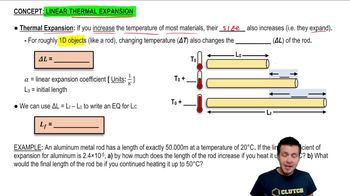
Use the formula for linear thermal expansion: \( \Delta L = \alpha L_0 \Delta T \), where \( \Delta L \) is the change in length, \( \alpha \) is the coefficient of linear expansion for steel, \( L_0 \) is the original length, and \( \Delta T \) is the change in temperature.
Substitute the known values into the formula: \( \Delta L = 0.471 \text{ ft} \), \( L_0 = 1671 \text{ ft} \), and \( \alpha \approx 11 \times 10^{-6} \text{ °C}^{-1} \) for steel.
Rearrange the formula to solve for \( \Delta T \): \( \Delta T = \frac{\Delta L}{\alpha L_0} \).
Calculate the final temperature by adding the change in temperature \( \Delta T \) to the initial temperature of 15.5°C: \( T = 15.5 + \Delta T \).

Risposta video verificata per un problema simile:

Questa soluzione video è stata consigliata dai nostri tutor come utile per risolvere questo problema.
Durata del video:
1m

Concetti chiave

Ecco i concetti essenziali che devi comprendere per rispondere correttamente alla domanda.

Thermal Expansion

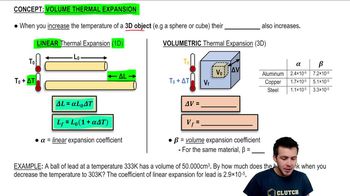
Thermal expansion refers to the tendency of matter to change in volume in response to a change in temperature. For solids like steel, this expansion is typically linear, meaning the length increases proportionally with temperature. Understanding this concept is crucial for calculating how much the height of a structure changes with temperature variations.
Video consigliato:
Percorso guidato
05:21
Volume Thermal Expansion

Coefficient of Linear Expansion

The coefficient of linear expansion is a material-specific constant that quantifies how much a material expands per degree change in temperature. For steel, this coefficient is approximately 12 x 10^-6 per degree Celsius. This value is essential for determining the change in dimensions of the building as the temperature changes.
Video consigliato:
Percorso guidato
07:31
Linear Thermal Expansion

Thermal Equilibrium

Thermal equilibrium occurs when two objects or systems reach the same temperature and no heat flows between them. In this scenario, the building is assumed to be in thermal equilibrium with the surrounding air, meaning its temperature matches the air temperature. This assumption allows us to use the measured height change to infer the air temperature.
Video consigliato:
Percorso guidato
05:21
Volume Thermal Expansion
Pratica correlata
Domanda del libro di testo

A 6.00-kg piece of solid copper metal at an initial temperature T is placed with 2.00 kg of ice that is initially at -20.0°C. The ice is in an insulated container of negligible mass and no heat is exchanged with the surroundings. After thermal equilibrium is reached, there is 1.20 kg of ice and 0.80 kg of liquid water. What was the initial temperature of the piece of copper?

576
views
Domanda del libro di testo

A steel tank is completely filled with 1.90 m3 of ethanol when both the tank and the ethanol are at 32.0°C. When the tank and its contents have cooled to 18.0°C, what additional volume of ethanol can be put into the tank?

1805
views
Domanda del libro di testo

The pressure of a gas at the triple point of water is 1.351.35 atm. If its volume remains unchanged, what will its pressure be at the temperature at which CO2 solidifies?

2632
views
Domanda del libro di testo

Like the Kelvin scale, the Rankine scale is an absolute temperature scale: Absolute zero is zero degrees Rankine (0°R). However, the units of this scale are the same size as those of the Fahrenheit scale rather than the Celsius scale. What is the numerical value of the triple-point temperature of water on the Rankine scale?

2204
views
Domanda del libro di testo

A geodesic dome constructed with an aluminum framework is a nearly perfect hemisphere; its diameter measures 55.0 m on a winter day at a temperature of -15°C. How much more interior space does the dome have in the summer, when the temperature is 35°C?

1839
views
Domanda del libro di testo

A constant-volume gas thermometer registers an absolute pressure corresponding to 325325 mm of mercury when in contact with water at the triple point. What pressure does it read when in contact with water at the normal boiling point?

2268
views