
Ch 17: Temperature and Heat
Young & Freedman Calc - University Physics 14th Edition
Young & Freedman Calc14th EditionUniversity PhysicsISBN: 9780321973610Non è quello che usi tu?Cambia libro di testo
Capitolo 17, Problema 34

You have 750 g of water at 10.0°C in a large insulated beaker. How much boiling water at 100.0°C must you add to this beaker so that the final temperature of the mixture will be 75°C?

Guida verificata passo dopo passo
1
First, identify the key concept involved: this is a heat transfer problem where the heat lost by the boiling water will be equal to the heat gained by the cooler water, assuming no heat is lost to the surroundings.
Use the formula for heat transfer: \( Q = mc\Delta T \), where \( Q \) is the heat energy, \( m \) is the mass, \( c \) is the specific heat capacity, and \( \Delta T \) is the change in temperature.
Set up the equation based on the principle of conservation of energy: \( m_1c\Delta T_1 = m_2c\Delta T_2 \), where \( m_1 \) and \( m_2 \) are the masses of the cooler and boiling water respectively, and \( \Delta T_1 \) and \( \Delta T_2 \) are their respective temperature changes.
Substitute the known values into the equation: \( 750 \text{ g} \times 4.18 \text{ J/g°C} \times (75°C - 10°C) = m_2 \times 4.18 \text{ J/g°C} \times (100°C - 75°C) \).
Solve for \( m_2 \), the mass of boiling water needed, by isolating \( m_2 \) on one side of the equation. This will give you the mass of boiling water required to achieve the desired final temperature.

Risposta video verificata per un problema simile:

Questa soluzione video è stata consigliata dai nostri tutor come utile per risolvere questo problema.
Durata del video:
3m

Concetti chiave

Ecco i concetti essenziali che devi comprendere per rispondere correttamente alla domanda.

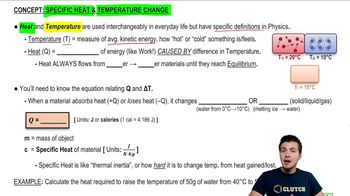
Specific Heat Capacity

Specific heat capacity is the amount of heat required to change the temperature of a unit mass of a substance by one degree Celsius. It is crucial in calculating the heat exchange in thermal processes, as it determines how much energy is needed to raise the temperature of a given mass of a substance. For water, this value is typically 4.18 J/g°C.
Video consigliato:
Percorso guidato
06:50
Specific Heat & Temperature Changes

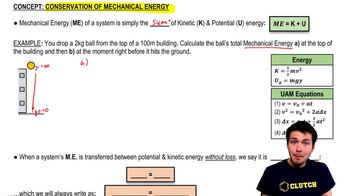
Conservation of Energy

The principle of conservation of energy states that energy cannot be created or destroyed, only transferred or converted from one form to another. In the context of mixing water at different temperatures, the heat lost by the hot water must equal the heat gained by the cold water, assuming no heat is lost to the surroundings due to the insulated beaker.
Video consigliato:
Percorso guidato
06:24
Conservation Of Mechanical Energy

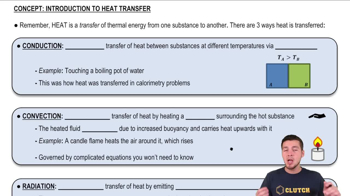
Heat Transfer in Mixtures

When two substances at different temperatures are mixed, heat transfer occurs until thermal equilibrium is reached. The final temperature of the mixture depends on the masses, specific heat capacities, and initial temperatures of the substances involved. This concept is used to set up equations that allow us to solve for unknown quantities, such as the mass of boiling water needed in this problem.
Video consigliato:
Percorso guidato
05:14
Overview of Heat Transfer
Pratica correlata
Domanda del libro di testo

In very cold weather a significant mechanism for heat loss by the human body is energy expended in warming the air taken into the lungs with each breath. On a cold winter day when the temperature is -20°C, what amount of heat is needed to warm to body temperature (37°C) the 0.50 L of air exchanged with each breath? Assume that the specific heat of air is 1020 J/kg K and that 1.0 L of air has mass 1.3 × 10⁻³ kg.

2370
views
Domanda del libro di testo

A copper calorimeter can with mass 0.100 kg contains 0.160 kg of water and 0.0180 kg of ice in thermal equilibrium at atmospheric pressure. If 0.750 kg of lead at 255°C is dropped into the calorimeter can, what is the final temperature? Assume that no heat is lost to the surroundings.

1953
views
Domanda del libro di testo

One suggested treatment for a person who has suffered a stroke is immersion in an ice-water bath at 0°C to lower the body temperature, which prevents damage to the brain. In one set of tests, patients were cooled until their internal temperature reached 32.0°C. To treat a 70.0 kg patient, what is the minimum amount of ice (at 0°C) you need in the bath so that its temperature remains at 0°C? The specific heat of the human body is 3480 J/kg C°, and recall that normal body temperature is 37.0°C.

1924
views
Domanda del libro di testo

A nail driven into a board increases in temperature. If we assume that 60% of the kinetic energy delivered by a 1.80 kg hammer with a speed of 7.80 m/s is transformed into heat that flows into the nail and does not flow out, what is the temperature increase of an 8.00 g aluminum nail after it is struck ten times?

2316
views
1
comments
Domanda del libro di testo

A blacksmith cools a 1.20 kg chunk of iron, initially at 650.0°C, by trickling 15.0°C water over it. All of the water boils away, and the iron ends up at 120.0°C. How much water did the blacksmith trickle over the iron?

2148
views
Domanda del libro di testo

While painting the top of an antenna 225 m in height, a worker accidentally lets a 1.00-L water bottle fall from his lunchbox. The bottle lands in some bushes at ground level and does not break. If a quantity of heat equal to the magnitude of the change in mechanical energy of the water goes into the water, what is its increase in temperature?

2092
views