
Ch 23: Electric Potential
Young & Freedman Calc - University Physics 14th Edition
Young & Freedman Calc14th EditionUniversity PhysicsISBN: 9780321973610Non è quello che usi tu?Cambia libro di testo
Capitolo 23, Problema 36c

Two large, parallel conducting plates carrying op­posite charges of equal magnitude are separated by 2.202.20 cm. The surface charge density for each plate has magnitude 47.047.0 nC/m^2. If the separation between the plates is doubled while the surface charge density is kept constant at the given value, what happens to the magnitude of the electric field and to the po­tential difference?

Guida verificata passo dopo passo
1
First, understand that the electric field between two parallel plates with surface charge density \( \sigma \) is given by \( E = \frac{\sigma}{\varepsilon_0} \), where \( \varepsilon_0 \) is the permittivity of free space. This formula indicates that the electric field depends only on the surface charge density and not on the distance between the plates.
Since the surface charge density \( \sigma \) remains constant, the magnitude of the electric field \( E \) will also remain constant even if the separation between the plates is doubled.
Next, consider the potential difference \( V \) between the plates, which is related to the electric field and the separation \( d \) by the equation \( V = E \cdot d \). This shows that the potential difference is directly proportional to the separation between the plates.
If the separation \( d \) is doubled, the potential difference \( V \) will also double, because \( V = E \cdot 2d \) when \( d \) is doubled.
In summary, when the separation between the plates is doubled, the electric field remains unchanged, but the potential difference doubles due to the increased separation.

Risposta video verificata per un problema simile:

Questa soluzione video è stata consigliata dai nostri tutor come utile per risolvere questo problema.
Durata del video:
2m

Concetti chiave

Ecco i concetti essenziali che devi comprendere per rispondere correttamente alla domanda.

Electric Field Between Parallel Plates

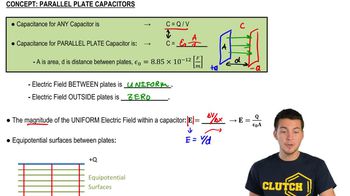
The electric field between two parallel plates is uniform and can be calculated using the formula E = σ/ε₀, where σ is the surface charge density and ε₀ is the permittivity of free space. This field is independent of the distance between the plates, meaning that doubling the separation does not affect the magnitude of the electric field.
Video consigliato:
Percorso guidato
08:53
Parallel Plate Capacitors

Potential Difference

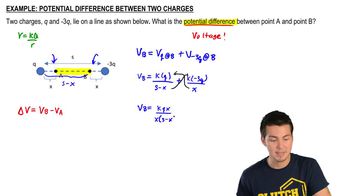
The potential difference (V) between two points in an electric field is given by V = E * d, where E is the electric field and d is the distance between the points. When the separation between the plates is doubled, the potential difference also doubles, as it is directly proportional to the distance between the plates.
Video consigliato:
Percorso guidato
07:04
Potential Difference Between Two Charges

Surface Charge Density

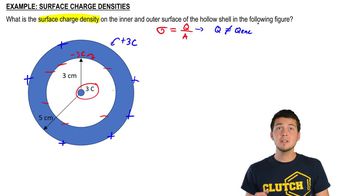
Surface charge density (σ) is the amount of charge per unit area on a surface. In this scenario, it remains constant even if the separation between the plates changes. It is a crucial factor in determining the electric field between the plates, as the field is directly proportional to the surface charge density.
Video consigliato:
Percorso guidato
04:03
Surface Charge Density
Pratica correlata
Domanda del libro di testo

A very long insulating cylinder of charge of radius 2.502.50 cm carries a uniform linear density of 15.015.0 nC/m. If you put one probe of a voltmeter at the surface, how far from the surface must the other probe be placed so that the voltmeter reads 175175 V?

3370
views
1
rank
Domanda del libro di testo

How much excess charge must be placed on a copper sphere 25.025.0 cm in diameter so that the potential of its center, rela­tive to infinity, is 3.753.75 kV? What is the potential of the sphere's surface relative to infinity?

2666
views
Domanda del libro di testo

A metal sphere with radius ra r_a is supported on an insulating stand at the center of a hollow, metal, spherical shell with radius rbr_b. There is charge +q+q on the inner sphere and charge −q-q on the outer spherical shell. Calculate the potential V(r)V(r) for (i) r<rar < r_a; (ii) ra<r<rbr_a < r < r_b; (iii) r>rbr > r_b. (Hint: The net potential is the sum of the potentials due to the individual spheres.) Take VV to be zero when rr is infinite.

1869
views
Domanda del libro di testo

Two large, parallel conducting plates carrying op­posite charges of equal magnitude are separated by 2.202.20 cm. If the surface charge density for each plate has magnitude 47.047.0 nC/m2, what is the magnitude of EE in the region between the plates?

1931
views
1
rank
Domanda del libro di testo

Certain sharks can detect an electric field as weak as 1.01.0 μμV/m. To grasp how weak this field is, if you wanted to produce it between two parallel metal plates by connecting an ordinary 1.51.5­V AA battery across these plates, how far apart would the plates have to be?

2026
views
Domanda del libro di testo

Two large, parallel conducting plates carrying op­posite charges of equal magnitude are separated by 2.202.20 cm. What is the potential difference between the two plates?

2111
views