
Ch 18: Thermal Properties of Matter
Young & Freedman Calc - University Physics 14th Edition
Young & Freedman Calc14th EditionUniversity PhysicsISBN: 9780321973610Non è quello che usi tu?Cambia libro di testo
Capitolo 18, Problema 23a

Modern vacuum pumps make it easy to attain pressures of the order of 10−1310^{-13} atm in the laboratory. Consider a volume of air and treat the air as an ideal gas. At a pressure of 9.00×10−149.00\(\times\)10^{-14} atm and an ordinary temperature of 300.0300.0 K, how many molecules are present in a volume of 1.001.00 cm3?

Guida verificata passo dopo passo
1
Start by recalling the Ideal Gas Law, which is given by the formula: PV=nRT, where P is the pressure, V is the volume, n is the number of moles, R is the ideal gas constant, and T is the temperature.
Convert the volume from cm³ to liters, since the ideal gas constant R is typically expressed in terms of liters. Remember that 1 cm³ is equal to 0.001 liters.
Use the Ideal Gas Law to solve for n, the number of moles. Rearrange the formula to n=PVRT. Substitute the given values: P=9.00 imes 10^{-14} atm, V=0.001 L, R=0.0821 L atm/mol K, and T=300.0 K.
Calculate the number of moles n using the rearranged formula. This will give you the amount of substance in moles present in the given volume under the specified conditions.
Finally, convert the number of moles to the number of molecules using Avogadro's number, which is 6.022 imes 10^{23} molecules/mol. Multiply the number of moles by Avogadro's number to find the total number of molecules in the 1.00 cm³ volume.

Risposta video verificata per un problema simile:

Questa soluzione video è stata consigliata dai nostri tutor come utile per risolvere questo problema.
Durata del video:
3m

Concetti chiave

Ecco i concetti essenziali che devi comprendere per rispondere correttamente alla domanda.

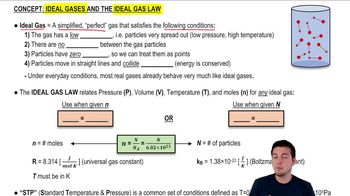
Ideal Gas Law

The Ideal Gas Law is a fundamental equation in physics that relates the pressure, volume, temperature, and number of molecules of a gas. It is expressed as PV = nRT, where P is pressure, V is volume, n is the number of moles, R is the ideal gas constant, and T is temperature. This law assumes that the gas molecules do not interact and occupy no volume, which is a good approximation under many conditions.
Video consigliato:
Percorso guidato
07:21
Ideal Gases and the Ideal Gas Law

Molecular Count in Gases

To find the number of molecules in a given volume of gas, we use Avogadro's number, which is 6.022 x 10^23 molecules per mole. By calculating the number of moles using the Ideal Gas Law and multiplying by Avogadro's number, we can determine the total number of molecules present. This concept is crucial for understanding the microscopic properties of gases.
Video consigliato:
Percorso guidato
01:50
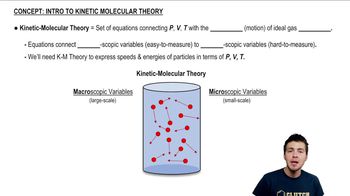
Introduction to Kinetic-Molecular Theory

Pressure Units and Conversion

Pressure is a measure of force exerted by gas molecules on the walls of a container. It is often expressed in atmospheres (atm), but can also be measured in other units like pascals (Pa) or torr. Understanding how to convert between these units is essential for solving problems involving gas laws, especially when dealing with extremely low pressures as in the given question.
Video consigliato:
Percorso guidato
07:46
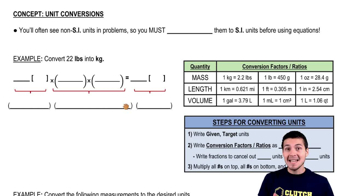
Unit Conversions
Pratica correlata
Domanda del libro di testo

At an altitude of 11,00011,000 m (a typical cruising altitude for a jet airliner), the air temperature is −56.5-56.5°C and the air density is 0.3640.364 kg/m3 . What is the pressure of the atmosphere at that altitude? (Note: The temperature at this altitude is not the same as at the surface of the earth, so the calculation of Example 18.418.4 in Section 18.118.1 doesn't apply.)

3209
views
Domanda del libro di testo

A large organic molecule has a mass of 1.41×10−211.41\(\times\)10^{-21} kg. What is the molar mass of this compound?

1766
views
Domanda del libro di testo

How many moles are in a 1.001.00-kg bottle of water? How many molecules? The molar mass of water is 18.018.0 g/mol.

2365
views
Domanda del libro di testo

Consider an ideal gas at 2727°C and 1.001.00 atm. To get some idea how close these molecules are to each other, on the average, imagine them to be uniformly spaced, with each molecule at the center of a small cube. What is the length of an edge of each cube if adjacent cubes touch but do not overlap?

1865
views
Domanda del libro di testo

Modern vacuum pumps make it easy to attain pressures of the order of 10−1310^{-13} atm in the laboratory. Consider a volume of air and treat the air as an ideal gas. How many molecules would be present at the same temperature but at 1.001.00 atm instead?

1600
views
Domanda del libro di testo

In a gas at standard conditions, what is the length of the side of a cube that contains a number of molecules equal to the population of the earth (about 7×1097\(\times\)10^9 people)?

1786
views