Ch 19: The First Law of Thermodynamics
Young & Freedman Calc - University Physics 14th Edition
Young & Freedman Calc14th EditionUniversity PhysicsISBN: 9780321973610Non è quello che usi tu?Cambia libro di testo
Capitolo 19, Problema 18d

A cylinder contains 0.01000.0100 mol of helium at T=27.0T = 27.0°C. If the gas is ideal, what is the change in its internal energy in part (a)? In part (b)? How do the two answers compare? Why?
(a) How much heat is needed to raise the temperature to 67.067.0°C while keeping the volume constant? Draw a pVpV-diagram for this process.
(b) If instead the pressure of the helium is kept constant, how much heat is needed to raise the temperature from 27.027.0°C to 67.067.0°C? Draw a pVpV-diagram for this process.

Guida verificata passo dopo passo
1
Step 1: Convert the initial and final temperatures from Celsius to Kelvin by adding 273.15 to each temperature. This is necessary because thermodynamic calculations require temperatures in Kelvin.
Step 2: For part (a), use the formula for heat transfer at constant volume: Q = nC_vΔT, where n is the number of moles, C_v is the molar heat capacity at constant volume for helium, and ΔT is the change in temperature. Calculate ΔT using the temperatures in Kelvin.
Step 3: For part (b), use the formula for heat transfer at constant pressure: Q = nC_pΔT, where C_p is the molar heat capacity at constant pressure for helium. Again, calculate ΔT using the temperatures in Kelvin.
Step 4: To understand the difference in heat required between parts (a) and (b), note that C_p > C_v for any gas. The additional heat in part (b) is used to do work on the surroundings as the gas expands at constant pressure.
Step 5: For part (d), calculate the change in internal energy using ΔU = nC_vΔT for both parts (a) and (b). The change in internal energy is the same for both processes because it depends only on the temperature change and not on the path taken (constant volume or constant pressure).

Risposta video verificata per un problema simile:

Questa soluzione video è stata consigliata dai nostri tutor come utile per risolvere questo problema.
Durata del video:
7m

Concetti chiave

Ecco i concetti essenziali che devi comprendere per rispondere correttamente alla domanda.

First Law of Thermodynamics

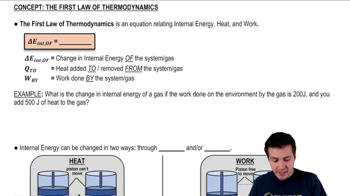
The First Law of Thermodynamics states that the change in internal energy of a system is equal to the heat added to the system minus the work done by the system. This principle is crucial for understanding how heat transfer and work affect the internal energy of the gas in both constant volume and constant pressure processes.
Video consigliato:
Percorso guidato
08:04
The First Law of Thermodynamics

Specific Heat Capacities

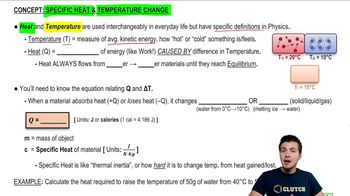
Specific heat capacity is the amount of heat required to change the temperature of a unit mass of a substance by one degree Celsius. For gases, specific heat capacity varies depending on whether the process is at constant volume (Cv) or constant pressure (Cp). This concept helps explain why different amounts of heat are required in parts (a) and (b) of the question.
Video consigliato:
Percorso guidato
06:50
Specific Heat & Temperature Changes

Ideal Gas Law

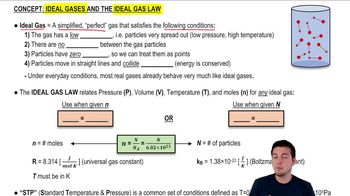
The Ideal Gas Law, expressed as PV = nRT, relates the pressure, volume, and temperature of an ideal gas. It is essential for understanding how changes in temperature affect pressure and volume in the given scenarios, and for drawing the pV-diagrams. This law also aids in calculating changes in internal energy and heat transfer for the helium gas.
Video consigliato:
Percorso guidato
07:21
Ideal Gases and the Ideal Gas Law
Pratica correlata
Domanda del libro di testo

A cylinder contains 0.01000.0100 mol of helium at T=27.0T = 27.0°C. If instead the pressure of the helium is kept constant, how much heat is needed to raise the temperature from 27.027.0°C to 67.067.0°C? Draw a pVpV-diagram for this process.

1335
views
Domanda del libro di testo

Propane gas (C3H8) behaves like an ideal gas with g=1.127g = 1.127. Determine the molar heat capacity at constant volume and the molar heat capacity at constant pressure.

2424
views
Domanda del libro di testo

A cylinder contains 0.01000.0100 mol of helium at T=27.0T = 27.0°C. What accounts for the difference between your answers to parts (a) and (b)? In which case is more heat required? What becomes of the additional heat?

(a) How much heat is needed to raise the temperature to 67.067.0°C while keeping the volume constant? Draw a pVpV-diagram for this process.

(b) If instead the pressure of the helium is kept constant, how much heat is needed to raise the temperature from 27.027.0°C to 67.067.0°C? Draw a pVpV-diagram for this process.

1265
views
Domanda del libro di testo

An experimenter adds 970970 J of heat to 1.751.75 mol of an ideal gas to heat it from 10.010.0°C to 25.025.0°C at constant pressure. The gas does +223+223 J of work during the expansion. Calculate γ\(\gamma\) for the gas.

1373
views
Domanda del libro di testo

A cylinder contains 0.01000.0100 mol of helium at T=27.0T = 27.0°C. How much heat is needed to raise the temperature to 67.067.0°C while keeping the volume constant? Draw a pVpV-diagram for this process.

1378
views
Domanda del libro di testo

Heat QQ flows into a monatomic ideal gas, and the volume increases while the pressure is kept constant. What fraction of the heat energy is used to do the expansion work of the gas?

1568
views