Ch 19: The First Law of Thermodynamics
Young & Freedman Calc - University Physics 14th Edition
Young & Freedman Calc14th EditionUniversity PhysicsISBN: 9780321973610Non è quello che usi tu?Cambia libro di testo
Capitolo 19, Problema 14b

When water is boiled at a pressure of 2.002.00 atm, the heat of vaporization is 2.20×1062.20\(\times\)10^6 J/kg and the boiling point is 120120°C. At this pressure, 1.001.00 kg of water has a volume of 1.00×10−31.00\(\times\)10^{-3} m3, and 1.001.00 kg of steam has a volume of 0.8240.824 m3. Compute the increase in internal energy of the water.

Guida verificata passo dopo passo
1
Identify the given values: pressure (P) = 2.00 atm, heat of vaporization (L) = 2.20 * 10^6 J/kg, initial volume of water (V1) = 1.00 * 10^-3 m^3, final volume of steam (V2) = 0.824 m^3, and mass (m) = 1.00 kg.
Convert the pressure from atm to pascals (Pa) using the conversion factor: 1 atm = 1.013 * 10^5 Pa. Therefore, P = 2.00 * 1.013 * 10^5 Pa.
Calculate the work done (W) during the expansion using the formula: W = P * (V2 - V1). Substitute the values for P, V2, and V1 to find the work done.
Use the first law of thermodynamics to find the change in internal energy (ΔU): ΔU = Q - W, where Q is the heat added to the system. Here, Q is equal to the heat of vaporization multiplied by the mass, Q = L * m.
Substitute the values of Q and W into the equation ΔU = Q - W to find the increase in internal energy of the water.

Risposta video verificata per un problema simile:

Questa soluzione video è stata consigliata dai nostri tutor come utile per risolvere questo problema.
Durata del video:
9m

Concetti chiave

Ecco i concetti essenziali che devi comprendere per rispondere correttamente alla domanda.

Heat of Vaporization

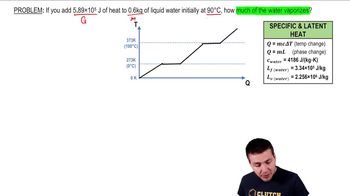
The heat of vaporization is the amount of energy required to convert a unit mass of a liquid into vapor without a temperature change. For water at 2.00 atm, this value is 2.20 * 10^6 J/kg. It is crucial for calculating the energy needed to vaporize water and understanding phase transitions.
Video consigliato:
Percorso guidato
05:00
Finding Amount of Water Vaporized

First Law of Thermodynamics

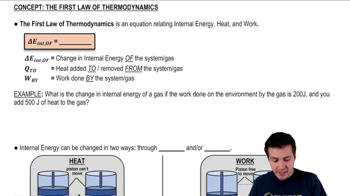
The First Law of Thermodynamics states that energy cannot be created or destroyed, only transformed. It is expressed as ΔU = Q - W, where ΔU is the change in internal energy, Q is the heat added to the system, and W is the work done by the system. This principle helps calculate the change in internal energy when water boils.
Video consigliato:
Percorso guidato
08:04
The First Law of Thermodynamics

Work Done by Expanding Gas

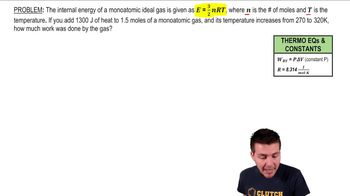
When a gas expands, it does work on its surroundings, calculated as W = PΔV, where P is the pressure and ΔV is the change in volume. In this scenario, the work done by the steam as it expands from liquid to gas at 2.00 atm is essential for determining the internal energy change during boiling.
Video consigliato:
Percorso guidato
03:47
Calculating Work Done on Monoatomic Gas
Pratica correlata
Domanda del libro di testo

A gas in a cylinder is held at a constant pressure of 1.80×1051.80\(\times\)10^5 Pa and is cooled and compressed from 1.701.70 m3 to 1.201.20 m3. The internal energy of the gas decreases by 1.40×1051.40\(\times\)10^5 J. Does it matter whether the gas is ideal? Why or why not?

1730
views

Domanda del libro di testo

During an isothermal compression of an ideal gas, 410410 J of heat must be removed from the gas to maintain constant temperature. How much work is done by the gas during the process?

2456
views
Domanda del libro di testo

The pVpV-diagram in Fig. E19.1319.13 shows a process abcabc involving 0.4500.450 mol of an ideal gas. How much heat had to be added during the process to increase the internal energy of the gas by 15,00015,000 J?

2232
views
Domanda del libro di testo

An ideal gas is taken from aa to bb on the pVpV-diagram shown in Fig. E19.1519.15. During this process, 700700 J of heat is added and the pressure doubles. How does the internal energy of the gas at aa compare to the internal energy at bb? Be specific and explain.

2321
views
Domanda del libro di testo

A cylinder contains 0.01000.0100 mol of helium at T=27.0T = 27.0°C. How much heat is needed to raise the temperature to 67.067.0°C while keeping the volume constant? Draw a pVpV-diagram for this process.

1378
views
Domanda del libro di testo

When water is boiled at a pressure of 2.002.00 atm, the heat of vaporization is 2.20×1062.20\(\times\)10^6 J/kg and the boiling point is 120120°C. At this pressure, 1.001.00 kg of water has a volume of 1.00×10−31.00\(\times\)10^{-3} m3, and 1.001.00 kg of steam has a volume of 0.8240.824 m3. Compute the work done when 1.001.00 kg of steam is formed at this temperature.

4116
views