
Ch 19: The First Law of Thermodynamics
Young & Freedman Calc - University Physics 14th Edition
Young & Freedman Calc14th EditionUniversity PhysicsISBN: 9780321973610Non è quello che usi tu?Cambia libro di testo
Capitolo 19, Problema 31

On a warm summer day, a large mass of air (atmospheric pressure 1.01×1051.01\(\times\)10^5 Pa) is heated by the ground to 26.026.0°C and then begins to rise through the cooler surrounding air. (This can be treated approximately as an adiabatic process; why?) Calculate the temperature of the air mass when it has risen to a level at which atmospheric pressure is only 0.850×1050.850\(\times\)10^5 Pa. Assume that air is an ideal gas, with g=1.40g = 1.40. (This rate of cooling for dry, rising air, corresponding to roughly 11 C° per 100100 m of altitude, is called the dry adiabatic lapse rate.)

Guida verificata passo dopo passo
1
Recognize that the problem involves an adiabatic process, where no heat is exchanged with the surroundings. This is because the air mass rises quickly enough that there is little time for heat exchange, making it approximately adiabatic.
Use the adiabatic process equation for an ideal gas: \( P_1 V_1^\gamma = P_2 V_2^\gamma \), where \( \gamma = 1.40 \) for air. This equation relates the initial and final pressures and volumes of the gas.
Since the process is adiabatic, we can also use the relation between pressure and temperature: \( \frac{T_2}{T_1} = \left( \frac{P_2}{P_1} \right)^{\frac{\gamma - 1}{\gamma}} \). This will allow us to find the final temperature \( T_2 \).
Convert the initial temperature from Celsius to Kelvin: \( T_1 = 26.0 + 273.15 \).
Substitute the known values into the temperature-pressure relation: \( T_2 = T_1 \times \left( \frac{0.850 \times 10^5}{1.01 \times 10^5} \right)^{\frac{1.40 - 1}{1.40}} \). Calculate \( T_2 \) to find the temperature of the air mass at the new pressure.

Risposta video verificata per un problema simile:

Questa soluzione video è stata consigliata dai nostri tutor come utile per risolvere questo problema.
Durata del video:
8m

Concetti chiave

Ecco i concetti essenziali che devi comprendere per rispondere correttamente alla domanda.

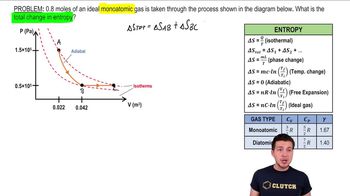
Adiabatic Process

An adiabatic process is a thermodynamic process in which no heat is exchanged with the surroundings. In the context of rising air, the process is considered adiabatic because the air mass expands and cools as it rises, without exchanging heat with the cooler surrounding air. This assumption simplifies calculations by focusing on changes in pressure and volume.
Video consigliato:
Percorso guidato
06:13
Entropy & Ideal Gas Processes

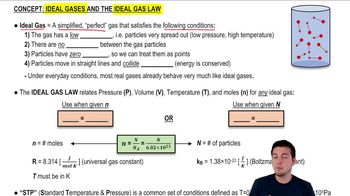
Ideal Gas Law

The ideal gas law relates the pressure, volume, and temperature of an ideal gas through the equation PV = nRT, where P is pressure, V is volume, T is temperature, n is the number of moles, and R is the ideal gas constant. This law is crucial for understanding how the temperature of the air mass changes as it rises and the pressure decreases, assuming the air behaves as an ideal gas.
Video consigliato:
Percorso guidato
07:21
Ideal Gases and the Ideal Gas Law

Dry Adiabatic Lapse Rate

The dry adiabatic lapse rate is the rate at which a rising parcel of dry air cools as it expands in the atmosphere, typically about 1°C per 100 meters of altitude. This concept is essential for calculating the temperature change of the air mass as it rises, given that the process is adiabatic and the air is assumed to be dry, meaning it contains no water vapor.
Video consigliato:
Percorso guidato
6:34
Fluid Speed & Volume Flow Rate