Ch 20: The Second Law of Thermodynamics
Young & Freedman Calc - University Physics 14th Edition
Young & Freedman Calc14th EditionUniversity PhysicsISBN: 9780321973610Non è quello che usi tu?Cambia libro di testo
Capitolo 20, Problema 20

A 4.504.50-kg block of ice at 0.000.00°C falls into the ocean and melts. The average temperature of the ocean is 3.503.50°C, including all the deep water. By how much does the change of this ice to water at 3.503.50°C alter the entropy of the world? Does the entropy increase or decrease? (Hint: Do you think that the ocean temperature will change appreciably as the ice melts?)

Guida verificata passo dopo passo
1
Step 1: Understand the problem. The block of ice melts and warms up to the ocean's temperature. The entropy change involves two processes: (1) the melting of ice at 0°C, and (2) the warming of the resulting water from 0°C to 3.5°C. The ocean's temperature is assumed constant due to its large thermal mass.
Step 2: Calculate the entropy change for the melting of ice. Use the formula ΔS = Q/T, where Q is the heat absorbed during melting and T is the temperature in kelvins. The heat absorbed during melting is Q = mL, where m is the mass of the ice and L is the latent heat of fusion of ice (L = 334,000 J/kg). Convert the temperature to kelvins: T = 273.15 K.
Step 3: Calculate the entropy change for warming the water. Use the formula ΔS = ∫(dQ/T), where dQ = mcΔT. Here, m is the mass of the water, c is the specific heat capacity of water (c = 4,186 J/(kg·K)), and ΔT is the temperature change (3.5°C - 0°C). Integrate over the temperature range from 273.15 K to 276.65 K.
Step 4: Combine the entropy changes. Add the entropy change from the melting process to the entropy change from warming the water to find the total entropy change of the ice-water system.
Step 5: Consider the ocean's entropy change. The heat lost by the ocean is equal to the heat gained by the ice-water system, but the ocean's temperature remains constant. Use ΔS = Q/T for the ocean, where T is the ocean's temperature in kelvins (276.65 K). Compare the entropy changes of the ice-water system and the ocean to determine if the total entropy of the world increases or decreases.

Risposta video verificata per un problema simile:

Questa soluzione video è stata consigliata dai nostri tutor come utile per risolvere questo problema.

Concetti chiave

Ecco i concetti essenziali che devi comprendere per rispondere correttamente alla domanda.

Entropy

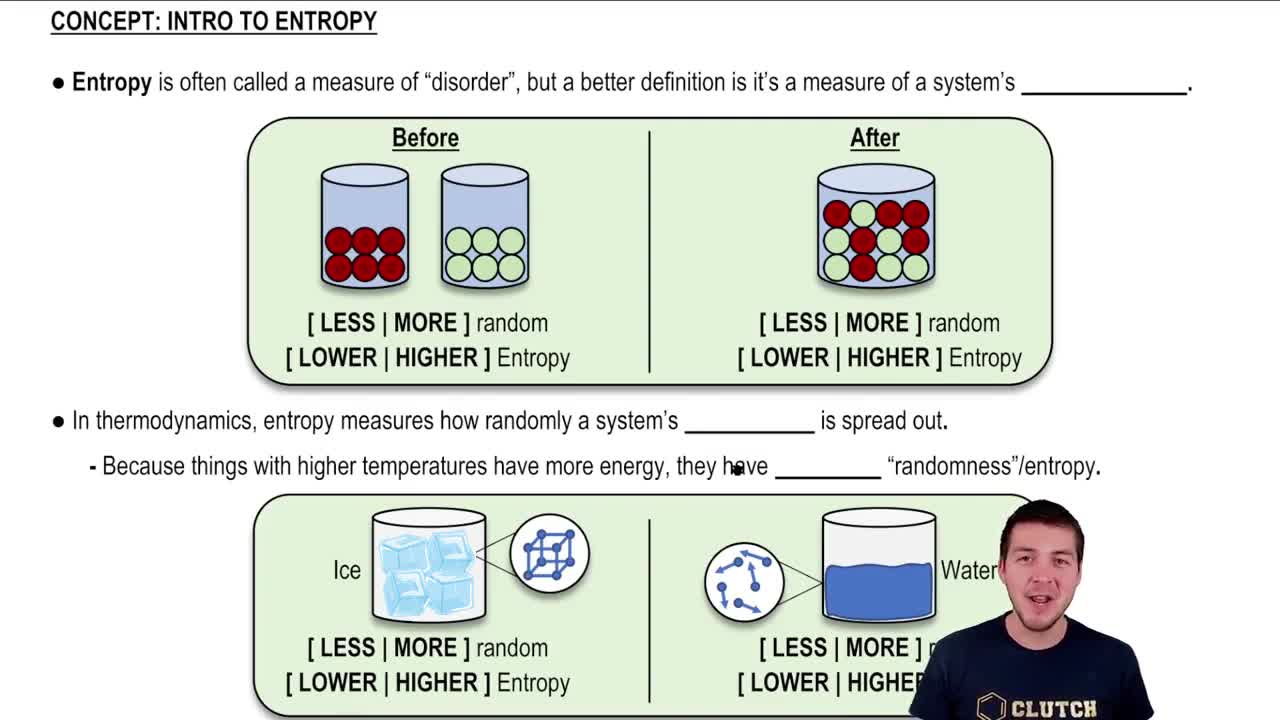
Entropy is a measure of the disorder or randomness in a system. In thermodynamics, it quantifies the amount of energy in a physical system that is not available to do work. When ice melts into water, the entropy of the system increases because the molecules in liquid water are more disordered than in solid ice. This concept is crucial for understanding how energy transformations affect the overall disorder of a system.
Video consigliato:
Percorso guidato
07:50
Intro to Entropy

Phase Change

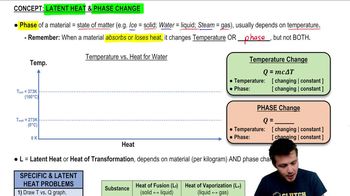
A phase change refers to the transition of a substance from one state of matter to another, such as from solid to liquid. During this process, energy is absorbed or released, but the temperature of the substance remains constant until the phase change is complete. In this scenario, the melting of ice at 0°C to water at 0°C involves a phase change that requires heat energy, which is essential for calculating the change in entropy.
Video consigliato:
Percorso guidato
10:40
Latent Heat & Phase Changes

Heat Transfer

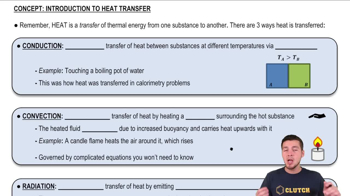
Heat transfer is the process of thermal energy moving from one object or substance to another due to a temperature difference. In this case, the heat from the warmer ocean water is absorbed by the ice, causing it to melt. Understanding heat transfer is vital for analyzing how the melting ice affects the temperature and entropy of the surrounding environment, particularly in relation to the ocean's average temperature.
Video consigliato:
Percorso guidato
05:14
Overview of Heat Transfer
Pratica correlata
Domanda del libro di testo

A sophomore with nothing better to do adds heat to 0.3500.350 kg of ice at 0.00.0°C until it is all melted. What is the change in entropy of the water?

2052
views

Domanda del libro di testo

A Carnot refrigerator is operated between two heat reservoirs at temperatures of 320320 K and 270270 K. What is the coefficient of performance of the refrigerator?

1790
views
Domanda del libro di testo

You decide to take a nice hot bath but discover that your thoughtless roommate has used up most of the hot water. You fill the tub with 195195 kg of 30.030.0°C water and attempt to warm it further by pouring in 5.005.00 kg of boiling water from the stove. Is this a reversible or an irreversible process? Use physical reasoning to explain.

1914
views
Domanda del libro di testo

A 15.015.0-kg block of ice at 0.00.0°C melts to liquid water at 0.00.0°C inside a large room at 20.020.0°C. Treat the ice and the room as an isolated system, and assume that the room is large enough for its temperature change to be ignored. Is the melting of the ice reversible or irreversible? Explain, using simple physical reasoning without resorting to any equations.

2072
views
Domanda del libro di testo

A Carnot refrigerator is operated between two heat reservoirs at temperatures of 320320 K and 270270 K. If the refrigerator completes 165165 cycles each minute, what power input is required to operate it?

1737
views
Domanda del libro di testo

A Carnot heat engine uses a hot reservoir consisting of a large amount of boiling water and a cold reservoir consisting of a large tub of ice and water. In 55 minutes of operation, the heat rejected by the engine melts 0.04000.0400 kg of ice. During this time, how much work WW is performed by the engine?

2769
views