
Ch 20: The Second Law of Thermodynamics
Young & Freedman Calc - University Physics 14th Edition
Young & Freedman Calc14th EditionUniversity PhysicsISBN: 9780321973610Non è quello che usi tu?Cambia libro di testo
Capitolo 20, Problema 11

A refrigerator has a coefficient of performance of 2.252.25, runs on an input of 135135 W of electrical power, and keeps its inside compartment at 55°C. If you put a dozen 1.01.0-L plastic bottles of water at 3131°C into this refrigerator, how long will it take for them to be cooled down to 5 5°C? (Ignore any heat that leaves the plastic.)

Guida verificata passo dopo passo
1
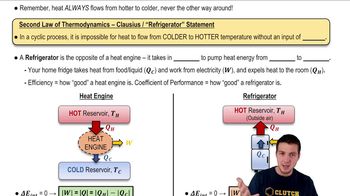
First, understand the concept of the coefficient of performance (COP) for a refrigerator, which is defined as the ratio of the heat removed from the cold reservoir (Q_c) to the work input (W). The formula is: QcW = COP.
Calculate the heat removed from the cold reservoir (Q_c) using the COP and the electrical power input. Rearrange the COP formula to find Q_c: Qc = COP × W. Substitute COP = 2.25 and W = 135 W to find Q_c.
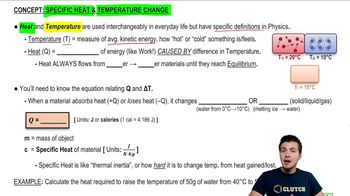
Determine the amount of heat that needs to be removed from the water bottles to cool them from 31°C to 5°C. Use the formula for heat transfer: Q = m × c × ΔT, where m is the mass of the water, c is the specific heat capacity of water (approximately 4.18 J/g°C), and ΔT is the change in temperature.
Calculate the mass of the water in the bottles. Since the density of water is approximately 1 g/mL, the mass of 1.0 L of water is 1000 g. Therefore, for a dozen bottles, the total mass is 12 × 1000 g.
Finally, calculate the time required to cool the water using the formula: t = QQc. Substitute the values for Q (from step 3) and Q_c (from step 2) to find the time.

Risposta video verificata per un problema simile:

Questa soluzione video è stata consigliata dai nostri tutor come utile per risolvere questo problema.
Durata del video:
3m

Concetti chiave

Ecco i concetti essenziali che devi comprendere per rispondere correttamente alla domanda.

Coefficient of Performance (COP)

The Coefficient of Performance (COP) is a measure of a refrigerator's efficiency, defined as the ratio of heat removed from the refrigerated space to the work input. In this problem, the COP is 2.25, meaning for every unit of energy consumed, 2.25 units of heat are removed from the refrigerator's interior.
Video consigliato:

Specific Heat Capacity

Specific heat capacity is the amount of heat required to change the temperature of a unit mass of a substance by one degree Celsius. For water, this value is approximately 4.18 J/g°C. This concept is crucial for calculating the total heat energy needed to cool the water bottles from 31°C to 5°C.
Video consigliato:
Percorso guidato
06:50
Specific Heat & Temperature Changes

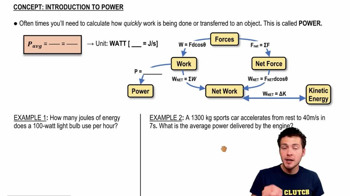
Energy Transfer and Power

Energy transfer in this context involves calculating the total energy required to cool the water and relating it to the power input of the refrigerator. Power, measured in watts, is the rate of energy transfer. Given the refrigerator's power input of 135 W, we can determine the time required to cool the water by dividing the total energy needed by the power input.
Video consigliato: