
Ch 21: Electric Charge and Electric Field
Young & Freedman Calc - University Physics 14th Edition
Young & Freedman Calc14th EditionUniversity PhysicsISBN: 9780321973610Non è quello che usi tu?Cambia libro di testo
Capitolo 21, Problema 55c

An electric dipole with dipole moment p p is in a uniform external electric field EE. Show that for the stable orientation in part (b), the dipole's own electric field tends to oppose the external field. Note: Part (b) asked which of the orientations in part (a) is stable, and which is unstable? (Hint: Consider a small rotation away from the equilibrium position and see what happens.) Also, part (a) asked to find the orientations of the dipole for which the torque on the dipole is zero.

Guida verificata passo dopo passo
1
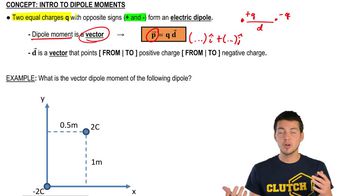
Understand the concept of an electric dipole: An electric dipole consists of two equal and opposite charges separated by a distance. The dipole moment \( \mathbf{p} \) is a vector quantity defined as \( \mathbf{p} = q \cdot \mathbf{d} \), where \( q \) is the charge and \( \mathbf{d} \) is the displacement vector from the negative to the positive charge.
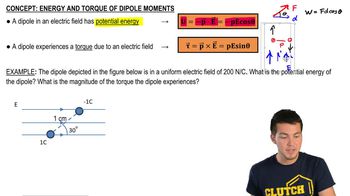
Recall the torque on a dipole in an electric field: The torque \( \mathbf{\tau} \) experienced by a dipole in a uniform electric field \( \mathbf{E} \) is given by \( \mathbf{\tau} = \mathbf{p} \times \mathbf{E} \). This torque tends to align the dipole with the electric field.
Identify the stable orientation: The stable orientation of a dipole in an electric field is when the dipole moment \( \mathbf{p} \) is aligned with the electric field \( \mathbf{E} \). In this orientation, the angle \( \theta \) between \( \mathbf{p} \) and \( \mathbf{E} \) is zero, minimizing the potential energy.
Consider the dipole's own electric field: The electric field due to the dipole itself is directed from the positive to the negative charge. In the stable orientation, this field is opposite to the direction of the external electric field \( \mathbf{E} \).
Conclude the opposition of fields: Since the dipole's own electric field is directed opposite to the external field in the stable orientation, it tends to oppose the external field, thereby stabilizing the dipole in that orientation.

Risposta video verificata per un problema simile:

Questa soluzione video è stata consigliata dai nostri tutor come utile per risolvere questo problema.
Durata del video:
4m

Concetti chiave

Ecco i concetti essenziali che devi comprendere per rispondere correttamente alla domanda.

Electric Dipole Moment

The electric dipole moment is a vector quantity that represents the separation of positive and negative charges within a system. It is defined as the product of the charge magnitude and the distance between the charges, pointing from the negative to the positive charge. In an external electric field, the dipole moment determines the torque experienced by the dipole.
Video consigliato:
Percorso guidato
03:08
Intro To Dipole Moment

Torque on a Dipole

Torque on an electric dipole in an external electric field is given by the cross product of the dipole moment and the electric field vector. This torque tends to align the dipole moment with the electric field, resulting in a stable orientation when the dipole moment is parallel to the field. The torque is zero when the dipole is aligned, indicating a stable equilibrium.
Video consigliato:
Percorso guidato
05:19
Energy & Torque of Dipole Moments

Electric Field of a Dipole

The electric field generated by a dipole is a vector field that varies with position around the dipole. It tends to oppose external fields when the dipole is in a stable orientation, as the dipole's field lines are directed opposite to the external field lines. This opposition is due to the dipole's attempt to minimize potential energy by aligning with the external field.
Video consigliato:
Percorso guidato
03:08
Intro To Dipole Moment
Pratica correlata
Domanda del libro di testo

The dipole moment of the water molecule (H2O) is 6.17×10−306.17\(\times\)10^{-30} Cm. Consider a water molecule located at the origin whose dipole moment pp points in the +x+x-direction. A chlorine ion (Cl-), of charge −1.60×10⁻¹⁹-1.60\(\times\)10^{-19} C, is located at x=3.00×10⁻⁹x=3.00\(\times\)10^{-9} m. Find the magnitude and direction of the electric force that the water molecule exerts on the chlorine ion. Is this force attractive or repulsive? Assume that xx is much larger than the separation dd between the charges in the dipole, so that the approximate expression for the electric field along the dipole axis derived in Example 21.1421.14 can be used.

645
views
Domanda del libro di testo

Point charges q1=−4.5q_1=-4.5 nC and q2=+4.5q_2=+4.5 nC are separated by 3.13.1 mm, forming an electric dipole. The charges are in a uniform electric field whose direction makes an angle of 36.936.9° with the line connecting the charges. What is the magnitude of this field if the torque exerted on the dipole has magnitude 7.2×10−97.2\(\times\)10^{-9} Nm?

2827
views
2
rank
Domanda del libro di testo

An electric dipole with dipole moment p p is in a uniform external electric field EE. Find the orientations of the dipole for which the torque on the dipole is zero.

2980
views
Domanda del libro di testo

An electric dipole with dipole moment p p is in a uniform external electric field EE. Which of the orientations in part (a) is stable, and which is unstable? (Hint: Consider a small rotation away from the equilibrium position and see what happens.) Note: Part (a) asked to find the orientations of the dipole for which the torque on the dipole is zero.

2658
views