
Ch 22: Gauss' Law
Young & Freedman Calc - University Physics 14th Edition
Young & Freedman Calc14th EditionUniversity PhysicsISBN: 9780321973610Non è quello che usi tu?Cambia libro di testo
Capitolo 22, Problema 1c

A flat sheet of paper of area 0.2500.250 m2 is oriented so that the normal to the sheet is at an angle of 6060° to a uniform electric field of magnitude 1414 N/C. For what angle ϕ\(\phi\) between the normal to the sheet and the electric field is the magnitude of the flux through the sheet (i) largest and (ii) smallest? Explain your answers.

Guida verificata passo dopo passo
1
Understand the concept of electric flux: Electric flux (Φ) through a surface is given by the formula Φ = E * A * cos(φ), where E is the electric field strength, A is the area of the surface, and φ is the angle between the normal to the surface and the direction of the electric field.
Identify the conditions for maximum and minimum flux: The cosine function, cos(φ), determines the variation of flux with angle φ. The flux is largest when cos(φ) is maximum, which occurs at φ = 0° (cos(0°) = 1). The flux is smallest when cos(φ) is minimum, which occurs at φ = 90° (cos(90°) = 0).
Explain why the flux is largest at φ = 0°: When the angle φ is 0°, the normal to the sheet is aligned with the electric field direction, maximizing the component of the field passing through the sheet. This results in the largest possible flux.
Explain why the flux is smallest at φ = 90°: At φ = 90°, the normal to the sheet is perpendicular to the electric field direction, meaning no component of the field passes through the sheet. This results in zero flux.
Summarize the findings: The magnitude of the electric flux through the sheet is largest when the angle φ is 0° and smallest when the angle φ is 90°, due to the properties of the cosine function in the electric flux formula.

Risposta video verificata per un problema simile:

Questa soluzione video è stata consigliata dai nostri tutor come utile per risolvere questo problema.
Durata del video:
4m

Concetti chiave

Ecco i concetti essenziali che devi comprendere per rispondere correttamente alla domanda.

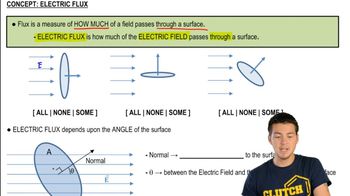
Electric Flux

Electric flux is a measure of the electric field passing through a given area. It is calculated as the product of the electric field magnitude, the area through which it passes, and the cosine of the angle between the field and the normal to the surface. This concept helps determine how much of the field interacts with the surface.
Video consigliato:

Angle Dependence of Flux

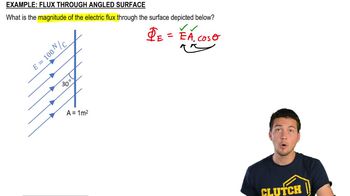
The angle between the electric field and the normal to the surface affects the electric flux. When the angle is 0°, the flux is maximized because the field is perpendicular to the surface, allowing maximum interaction. Conversely, at 90°, the flux is minimized as the field is parallel to the surface, resulting in no interaction.
Video consigliato:
Percorso guidato
02:01
Flux Through Angled Surface

Cosine Function in Flux Calculation

The cosine function is crucial in calculating electric flux, as it accounts for the angle's effect on the field's interaction with the surface. The flux is proportional to the cosine of the angle, meaning it decreases as the angle increases from 0° to 90°. Understanding this relationship is key to predicting flux behavior at different angles.
Video consigliato:
Percorso guidato
03:12
Calculating Wave Speed from Wave Functions