
Ch 22: Gauss' Law
Young & Freedman Calc - University Physics 14th Edition
Young & Freedman Calc14th EditionUniversity PhysicsISBN: 9780321973610Non è quello che usi tu?Cambia libro di testo
Capitolo 22, Problema 29b

An infinitely long cylindrical conductor has radius r r and uniform surface charge density σσ. In terms of σσ, what is the magnitude of the electric field produced by the charged cylinder at a distance r>Rr > R from its axis? Then, express the result in terms of λλ and show that the electric field outside the cylinder is the same as if all the charge were on the axis.

Guida verificata passo dopo passo
1
To find the electric field at a distance r > R from the axis of the cylinder, we use Gauss's Law. Gauss's Law states that the electric flux through a closed surface is equal to the charge enclosed divided by the permittivity of free space, \( \varepsilon_0 \).
Consider a cylindrical Gaussian surface of radius r and length L, coaxial with the charged cylinder. The electric field \( E \) is radial and constant over this surface, and the surface area of the cylindrical Gaussian surface is \( 2\pi r L \).
According to Gauss's Law, \( \Phi = E \cdot 2\pi r L = \frac{Q_{\text{enclosed}}}{\varepsilon_0} \). The charge enclosed by the Gaussian surface is \( Q_{\text{enclosed}} = \sigma \cdot 2\pi R L \), where \( \sigma \) is the surface charge density and \( R \) is the radius of the cylinder.
Substitute \( Q_{\text{enclosed}} \) into Gauss's Law: \( E \cdot 2\pi r L = \frac{\sigma \cdot 2\pi R L}{\varepsilon_0} \). Simplify to find the electric field: \( E = \frac{\sigma R}{\varepsilon_0 r} \).
To express the electric field in terms of linear charge density \( \lambda \), note that \( \lambda = \sigma \cdot 2\pi R \). Substitute \( \lambda \) into the expression for \( E \): \( E = \frac{\lambda}{2\pi \varepsilon_0 r} \). This shows that the electric field outside the cylinder is the same as if all the charge were concentrated along the axis.

Risposta video verificata per un problema simile:

Questa soluzione video è stata consigliata dai nostri tutor come utile per risolvere questo problema.
Durata del video:
4m

Concetti chiave

Ecco i concetti essenziali che devi comprendere per rispondere correttamente alla domanda.

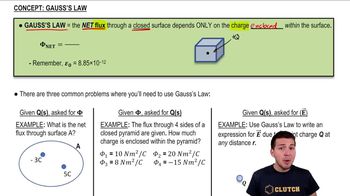
Gauss's Law

Gauss's Law relates the electric flux through a closed surface to the charge enclosed by that surface. For a cylindrical conductor, it helps determine the electric field by considering a Gaussian surface coaxial with the cylinder. The symmetry of the problem simplifies calculations, as the electric field is uniform over the surface.
Video consigliato:

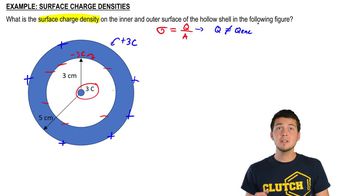
Surface Charge Density

Surface charge density, denoted by σ, is the amount of charge per unit area on the surface of a conductor. It is crucial for calculating the total charge on the cylindrical surface, which is used in Gauss's Law to find the electric field. Understanding σ allows us to relate it to linear charge density λ for further analysis.
Video consigliato:
Percorso guidato
04:03
Surface Charge Density

Linear Charge Density

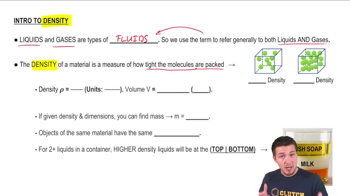
Linear charge density, λ, is the charge per unit length along a line, such as the axis of a cylinder. In this problem, it is used to express the electric field outside the cylinder, showing that the field behaves as if all the charge were concentrated along the axis. This simplification is possible due to the symmetry and infinite length of the cylinder.
Video consigliato:
Percorso guidato
8:13
Intro to Density
Pratica correlata
Domanda del libro di testo

A very large, horizontal, nonconducting sheet of charge has uniform charge per unit area σ=5.00×10⁻⁶\(\sigma\)=5.00\(\times\)10^{-6} C/m2. A small sphere of mass m=8.00×10⁻⁶m=8.00\(\times\)10^{-6} kg and charge qq is placed 3.00 3.00 cm above the sheet of charge and then released from rest. If the sphere is to remain motionless when it is released, what must be the value of qq?

2571
views
Domanda del libro di testo

A very large, horizontal, nonconducting sheet of charge has uniform charge per unit area σ=5.00×10⁻⁶\(\sigma\)=5.00\(\times\)10^{-6} C/m2. A small sphere of mass m=8.00×10⁻⁶m=8.00\(\times\)10^{-6} kg and charge qq is placed 3.00 3.00 cm above the sheet of charge and then released from rest. What is qq if the sphere is released 1.501.50 cm above the sheet?

1698
views
Domanda del libro di testo

A very long conducting tube (hollow cylinder) has inner radius AA and outer radius bb. It carries charge per unit length +α+α, where αα is a positive constant with units of C/m. A line of charge lies along the axis of the tube. The line of charge has charge per unit length. What is the charge per unit length on (i) the inner surface of the tube and (ii) the outer surface of the tube?

3589
views
Domanda del libro di testo

An infinitely long cylindrical conductor has radius r r and uniform surface charge density σσ. In terms of σσ and RR, what is the charge per unit length λλ for the cylinder?

2450
views
1
rank
Domanda del libro di testo

A very long conducting tube (hollow cylinder) has inner radius AA and outer radius bb. It carries charge per unit length +α+α, where αα is a positive constant with units of C/m. A line of charge lies along the axis of the tube. The line of charge has charge per unit length. Calculate the electric field in terms of αα and the distance rr from the axis of the tube for (i) r<ar < a; (ii) a<r<ba < r < b; (iii) r>br > b. Show your results in a graph of EE as a function of RR.

2382
views
1
rank