
Ch 24: Capacitance and Dielectrics
Young & Freedman Calc - University Physics 14th Edition
Young & Freedman Calc14th EditionUniversity PhysicsISBN: 9780321973610Non è quello che usi tu?Cambia libro di testo
Capitolo 24, Problema 7

A parallel-plate air capacitor is to store charge of magnitude 240.0240.0 pC on each plate when the potential difference between the plates is 42.042.0 V.
(a) If the area of each plate is 6.806.80 cm2, what is the separation between the plates?
(b) If the separation between the two plates is double the value calculated in part (a), what potential difference is required for the capacitor to store charge of magnitude 240.0240.0 pC on each plate?

Guida verificata passo dopo passo
1
Step 1: Begin by understanding the relationship between charge (Q), capacitance (C), and potential difference (V) in a capacitor, given by the formula: Q=CV. Here, Q is the charge, C is the capacitance, and V is the potential difference.
Step 2: For a parallel-plate capacitor, the capacitance can be calculated using the formula: C=εAd, where ε is the permittivity of free space (approximately 8.85×10^-12 F/m), A is the area of the plates, and d is the separation between the plates.
Step 3: Rearrange the formula from Step 2 to solve for the separation distance d: d=εAC. Substitute the values for ε, A (converted to m²), and C (calculated from Step 1 using C=QV) to find d.
Step 4: For part (b), if the separation between the plates is doubled, the new separation is 2d. Use the formula for capacitance again, C=εA2d, to find the new capacitance.
Step 5: Finally, use the relationship Q=CV again to solve for the new potential difference V required to store the same charge Q with the new capacitance calculated in Step 4.

Risposta video verificata per un problema simile:

Questa soluzione video è stata consigliata dai nostri tutor come utile per risolvere questo problema.
Durata del video:
7m

Concetti chiave

Ecco i concetti essenziali che devi comprendere per rispondere correttamente alla domanda.

Capacitance

Capacitance is the ability of a capacitor to store charge per unit voltage, defined by the formula C = Q/V, where C is capacitance, Q is charge, and V is voltage. For parallel-plate capacitors, capacitance is also given by C = ε₀A/d, where ε₀ is the permittivity of free space, A is the area of the plates, and d is the separation between them.
Video consigliato:
Percorso guidato
08:02
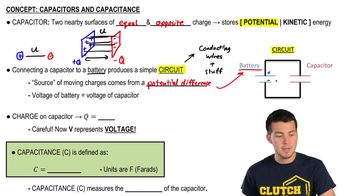
Capacitors & Capacitance (Intro)

Parallel-Plate Capacitor

A parallel-plate capacitor consists of two conductive plates separated by an insulating material (dielectric). The capacitance depends on the area of the plates and the distance between them, as well as the dielectric material. It is a fundamental component in circuits for storing electrical energy and controlling voltage levels.
Video consigliato:
Percorso guidato
08:53
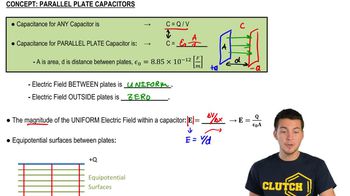
Parallel Plate Capacitors

Permittivity of Free Space

The permittivity of free space, denoted as ε₀, is a constant that characterizes the ability of a vacuum to permit electric field lines. It is approximately 8.85 x 10⁻¹² F/m (farads per meter) and is crucial in calculating the capacitance of capacitors, especially in the formula C = ε₀A/d for parallel-plate capacitors.
Video consigliato:
Percorso guidato
5:05
Spinning Space Station
Pratica correlata
Domanda del libro di testo

A 5.005.00-μ\(\mu\)F parallel-plate capacitor is connected to a 12.012.0 V battery. After the capacitor is fully charged, the battery is disconnected without loss of any of the charge on the plates.

(a) A voltmeter is connected across the two plates without discharging them. What does it read?

(b) What would the voltmeter read if (i) the plate separation were doubled; (ii) the radius of each plate were doubled but their separation was unchanged?

2866
views
1
rank
Domanda del libro di testo

The plates of a parallel-plate capacitor are 2.502.50 mm apart, and each carries a charge of magnitude 80.080.0 nC. The plates are in vacuum. The electric field between the plates has a magnitude of 4.00×1064.00\(\times\)10^6 V/m. What is (a) the potential difference between the plates; (b) the area of each plate; (c) the capacitance?

1767
views
Domanda del libro di testo

A capacitor is made from two hollow, coaxial, iron cylinders, one inside the other. The inner cylinder is negatively charged and the outer is positively charged; the magnitude of the charge on each is 10.010.0 pC. The inner cylinder has radius 0.500.50 mm, the outer one has radius 5.005.00 mm, and the length of each cylinder is 18.018.0 cm.

(a) What is the capacitance?

(b) What applied potential difference is necessary to produce these charges on the cylinders?

1975
views
Domanda del libro di testo

Figure E24.1424.14 shows a system of four capacitors, where the potential difference across ab is 50.050.0 V. How much charge is stored by this combination of capacitors?

1807
views
Domanda del libro di testo

A parallel-plate air capacitor of capacitance 245245 pF has a charge of magnitude 0.148 0.148 μ\(\mu\)C on each plate. The plates are 0.3280.328 mm apart.

(a) What is the potential difference between the plates?

(b) What is the area of each plate?

(c) What is the electric field magnitude between the plates?

(d) What is the surface charge density on each plate?

1666
views
Domanda del libro di testo

A spherical capacitor contains a charge of 3.303.30 nC when connected to a potential difference of 220220 V. If its plates are separated by vacuum and the inner radius of the outer shell is 4.004.00 cm, calculate: (a) the capacitance; (b) the radius of the inner sphere; (c) the electric field just outside the surface of the inner sphere.

2452
views