
Ch 27: Magnetic Field and Magnetic Forces
Young & Freedman Calc - University Physics 14th Edition
Young & Freedman Calc14th EditionUniversity PhysicsISBN: 9780321973610Non è quello che usi tu?Cambia libro di testo
Capitolo 27, Problema 29

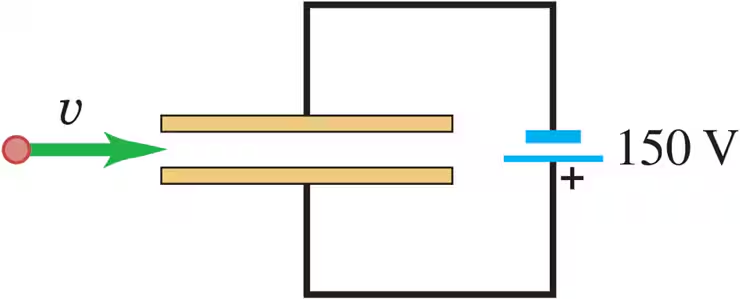
A 150 V battery is connected across two parallel metal plates of area 28.5 cm2 and separation 8.20 mm. A beam of alpha particles (charge +2e, mass 6.64 x 10⁻²⁷ kg) is accelerated from rest through a potential difference of 1.75 kV and enters the region between the plates perpendicular to the electric field, as shown in Fig. E27.29. What magnitude and direction of magnetic field are needed so that the alpha particles emerge undeflected from between the plates?

Guida verificata passo dopo passo
1
First, understand that for the alpha particles to emerge undeflected, the magnetic force must balance the electric force acting on them. The electric force \( F_e \) is given by \( F_e = qE \), where \( q \) is the charge of the alpha particle and \( E \) is the electric field between the plates.
Calculate the electric field \( E \) between the plates using the formula \( E = \frac{V}{d} \), where \( V \) is the potential difference across the plates (150 V) and \( d \) is the separation between the plates (8.20 mm).
The magnetic force \( F_m \) on a moving charge in a magnetic field is given by \( F_m = qvB \), where \( v \) is the velocity of the alpha particle and \( B \) is the magnetic field. For the particle to be undeflected, set \( F_e = F_m \), leading to \( qE = qvB \).
Solve for the velocity \( v \) of the alpha particles using the kinetic energy gained from the potential difference they were accelerated through: \( \frac{1}{2}mv^2 = qV_{acc} \), where \( V_{acc} \) is 1.75 kV. Rearrange to find \( v = \sqrt{\frac{2qV_{acc}}{m}} \).
Finally, solve for the magnetic field \( B \) using the equation \( B = \frac{E}{v} \). Substitute the expressions for \( E \) and \( v \) to find the magnitude of \( B \). The direction of \( B \) should be perpendicular to both the velocity of the particles and the electric field, following the right-hand rule.

Risposta video verificata per un problema simile:

Questa soluzione video è stata consigliata dai nostri tutor come utile per risolvere questo problema.
Durata del video:
11m

Concetti chiave

Ecco i concetti essenziali che devi comprendere per rispondere correttamente alla domanda.

Electric Field

An electric field is a region around a charged object where other charged objects experience a force. In this scenario, the electric field is created by the parallel plates connected to a 150-V battery, influencing the motion of charged particles like alpha particles. The field's strength is determined by the voltage and separation between the plates.
Video consigliato:
Percorso guidato
03:16
Intro to Electric Fields

Lorentz Force

The Lorentz force is the force experienced by a charged particle moving through electric and magnetic fields. It is the sum of the electric force and the magnetic force acting on the particle. For the alpha particles to remain undeflected, the magnetic force must counterbalance the electric force, requiring precise calculation of the magnetic field's magnitude and direction.
Video consigliato:
Percorso guidato
13:39
Lorentz Transformations of Velocity

Magnetic Field

A magnetic field exerts a force on moving charged particles, influencing their trajectory. In this problem, the magnetic field must be oriented such that it cancels the deflection caused by the electric field on the alpha particles. The direction and magnitude of the magnetic field are crucial for ensuring the particles pass through the plates without deviation.
Video consigliato:
Percorso guidato
05:30
Magnetic Fields and Magnetic Dipoles
Pratica correlata
Domanda del libro di testo

A straight, 2.5 m wire carries a typical household current of 1.5 A (in one direction) at a location where the earth's magnetic field is 0.55 gauss from south to north. Find the magnitude and direction of the force that our planet's magnetic field exerts on this wire if it is oriented so that the current in it is running (a) from west to east, (b) vertically upward, (c) from north to south. (d) Is the magnetic force ever large enough to cause significant effects under normal household conditions?

2863
views
Domanda del libro di testo

In a cyclotron, the orbital radius of protons with energy 300 keV is 16.0 cm. You are redesigning the cyclotron to be used instead for alpha particles with energy 300 keV. An alpha particle has charge q = +2e and mass m = 6.64 x 10⁻²⁷ kg. If the magnetic field isn't changed, what will be the orbital radius of the alpha particles?

1671
views
Domanda del libro di testo

A beam of protons traveling at 1.20 km/s enters a uniform magnetic field, traveling perpendicular to the field. The beam exits the magnetic field, leaving the field in a direction perpendicular to its original direction (Fig. E27.24) . The beam travels a distance of 1.18 cm while in the field. What is the magnitude of the magnetic field?

2111
views
1
rank
Domanda del libro di testo

Singly ionized (one electron removed) atoms are accelerated and then passed through a velocity selector consisting of perpendicular electric and magnetic fields. The electric field is 155 V/m and the magnetic field is 0.0315 T. The ions next enter a uniform magnetic field of magnitude 0.0175 T that is oriented perpendicular to their velocity. (a) How fast are the ions moving when they emerge from the velocity selector? (b) If the radius of the path of the ions in the second magnetic field is 17.5 cm, what is their mass?

2510
views
Domanda del libro di testo

A long wire carrying 4.50 A of current makes two 90° bends, as shown in Fig. E27.35. The bent part of the wire passes through a uniform 0.240 T magnetic field directed as shown in the figure and confined to a limited region of space. Find the magnitude and direction of the force that the magnetic field exerts on the wire.

5198
views
Domanda del libro di testo

A deuteron (the nucleus of an isotope of hydrogen) has a mass of 3.34 x 10⁻²⁷ kg and a charge of +e. The deuteron travels in a circular path with a radius of 6.96 mm in a magnetic field with magnitude 2.50 T. (a) Find the speed of the deuteron. (b) Find the time required for it to make half a revolution. (c) Through what potential difference would the deuteron have to be accelerated to acquire this speed?

2337
views