A flat, square surface with side length is in the xy-plane at . Calculate the magnitude of the flux through this surface produced by a magnetic field .
Ch 27: Magnetic Field and Magnetic Forces
Young & Freedman Calc14th EditionUniversity PhysicsISBN: 9780321973610Non è quello che usi tu?Cambia libro di testo
Tutti i libri di testo
Young & Freedman Calc 14th Edition
Ch 27: Magnetic Field and Magnetic Forces
Problema 5
Young & Freedman Calc 14th Edition
Ch 27: Magnetic Field and Magnetic Forces
Problema 5Capitolo 27, Problema 5
An electron experiences a magnetic force of magnitude 4.60 x10⁻¹⁵ N when moving at an angle of 60.0° with respect to a magnetic field of magnitude 3.50 x 10⁻³ T. Find the speed of the electron.
Guida verificata passo dopo passo1
Identify the formula for the magnetic force on a moving charge: \( F = qvB \sin(\theta) \), where \( F \) is the magnetic force, \( q \) is the charge of the electron, \( v \) is the speed of the electron, \( B \) is the magnetic field strength, and \( \theta \) is the angle between the velocity and the magnetic field.
Rearrange the formula to solve for the speed \( v \): \( v = \frac{F}{qB \sin(\theta)} \).
Substitute the known values into the equation: \( F = 4.60 \times 10^{-15} \) N, \( q = 1.60 \times 10^{-19} \) C (the charge of an electron), \( B = 3.50 \times 10^{-3} \) T, and \( \theta = 60.0^\circ \).
Calculate \( \sin(60.0^\circ) \), which is a trigonometric function value that can be found using a calculator or trigonometric table.
Substitute all the values into the rearranged formula to find \( v \): \( v = \frac{4.60 \times 10^{-15}}{1.60 \times 10^{-19} \times 3.50 \times 10^{-3} \times \sin(60.0^\circ)} \).

Risposta video verificata per un problema simile:
Questa soluzione video è stata consigliata dai nostri tutor come utile per risolvere questo problema.
Durata del video:
3mConcetti chiave
Ecco i concetti essenziali che devi comprendere per rispondere correttamente alla domanda.
Magnetic Force on a Moving Charge
The magnetic force on a moving charge is given by the equation F = qvBsin(θ), where F is the force, q is the charge, v is the velocity of the charge, B is the magnetic field strength, and θ is the angle between the velocity and the magnetic field. This equation is crucial for determining the speed of the electron in the given problem.
Video consigliato:
Percorso guidato
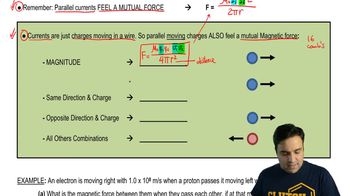
Magnetic Force Between Two Moving Charges
Trigonometric Functions
Trigonometric functions, such as sine, are used to resolve components of vectors in physics. In this context, sin(θ) is used to calculate the component of the velocity that is perpendicular to the magnetic field, which is necessary for determining the magnetic force experienced by the electron.
Video consigliato:
Percorso guidato
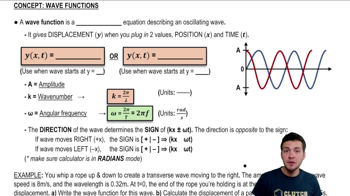
Intro to Wave Functions
Electron Charge
The charge of an electron is a fundamental constant, approximately -1.60x10^-19 C. Knowing this value is essential for calculating the speed of the electron, as it is a key variable in the equation for magnetic force. The negative sign indicates the electron's negative charge, but the magnitude is used in calculations involving force.
Video consigliato:
Percorso guidato
Electrons In Water (Using Density)
Pratica correlata
Domanda del libro di testo
2855
views
Domanda del libro di testo
A particle with mass and a charge of has, at a given instant, a velocity . What are the magnitude and direction of the particle's acceleration produced by a uniform magnetic field ?
3743
views
Domanda del libro di testo
A horizontal rectangular surface has dimensions 2.80 cm by 3.20 cm and is in a uniform magnetic field that is directed at an angle of 30.0° above the horizontal. What must the magnitude of the magnetic field be to produce a flux of 3.10 x 10⁻⁴ Wb through the surface?
2391
views
Domanda del libro di testo
A circular area with a radius of 6.50 cm lies in the xy-plane. What is the magnitude of the magnetic flux through this circle due to a uniform magnetic field B = 0.230 T at an angle of 53.1° from the +z-direction?
2396
views