
Ch 31: Alternating Current
Young & Freedman Calc - University Physics 14th Edition
Young & Freedman Calc14th EditionUniversity PhysicsISBN: 9780321973610Non è quello che usi tu?Cambia libro di testo
Capitolo 31, Problema 2a

A sinusoidal current i = I cosωt has an rms value Irms = 2.10 A. What is the current amplitude?

Guida verificata passo dopo passo
1
Understand the relationship between the rms value and the amplitude of a sinusoidal current. The rms (root mean square) value is a measure of the effective value of a varying current, and for a sinusoidal current, it is related to the amplitude by the formula: I_rms = I_amplitude / sqrt(2).
Identify the given values in the problem. You are provided with the rms value of the current, I_rms = 2.10 A.
Use the formula to express the amplitude in terms of the rms value: I_amplitude = I_rms * sqrt(2).
Substitute the given rms value into the formula: I_amplitude = 2.10 A * sqrt(2).
Calculate the amplitude using the expression from the previous step. This will give you the current amplitude, which is the peak value of the sinusoidal current.

Risposta video verificata per un problema simile:

Questa soluzione video è stata consigliata dai nostri tutor come utile per risolvere questo problema.
Durata del video:
1m

Concetti chiave

Ecco i concetti essenziali che devi comprendere per rispondere correttamente alla domanda.

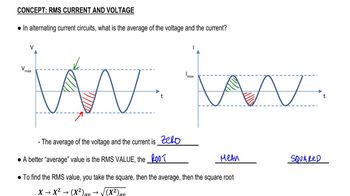
RMS Value

The root mean square (RMS) value of a sinusoidal current is a measure of the effective value of the alternating current. It is calculated as the square root of the average of the squares of the instantaneous values over one cycle. For a sinusoidal waveform, the RMS value is I_rms = I_0/√2, where I_0 is the amplitude.
Video consigliato:
Percorso guidato
07:14
RMS Current and Voltage

Current Amplitude

Current amplitude, denoted as I_0, is the peak value of the sinusoidal current. It represents the maximum instantaneous value that the current reaches during its cycle. In the context of RMS calculations, the amplitude is crucial for determining the effective current value using the relationship I_rms = I_0/√2.
Video consigliato:
Percorso guidato
05:38
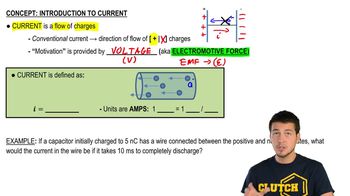
Intro to Current

Sinusoidal Waveform

A sinusoidal waveform is a mathematical curve that describes a smooth periodic oscillation. It is characterized by its amplitude, frequency, and phase. In electrical circuits, sinusoidal currents and voltages are common, and their analysis involves understanding these parameters to determine effective values like RMS and peak amplitude.
Video consigliato:
Percorso guidato
03:32
Superposition of Sinusoidal Wave Functions