
Ch 31: Alternating Current
Young & Freedman Calc - University Physics 14th Edition
Young & Freedman Calc14th EditionUniversity PhysicsISBN: 9780321973610Non è quello che usi tu?Cambia libro di testo
Capitolo 31, Problema 34bc

Off to Europe! You plan to take your hair dryer to Europe, where the electrical outlets put out 240 V instead of the 120 V seen in the United States. The dryer puts out 1600 W at 120 V. (b) What current will your dryer draw from a European outlet? (c) What resistance will your dryer appear to have when operated at 240 V?

Guida verificata passo dopo passo
1
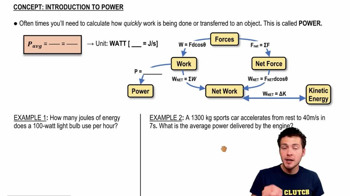
To find the current drawn by the dryer from a European outlet, we first need to understand the relationship between power, voltage, and current. The power (P) is given by the formula: P = V * I, where V is the voltage and I is the current.
Given that the dryer outputs 1600 W at 120 V, we can calculate the current it draws in the United States using the formula: I = P / V. Substitute the given values to find the current at 120 V.
Now, to find the current at 240 V, we assume the power output remains the same (1600 W). Use the formula I = P / V again, but this time substitute 240 V for the voltage.
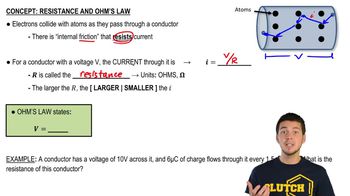
To find the resistance of the dryer when operated at 240 V, use Ohm's Law, which states that V = I * R, where R is the resistance. Rearrange this to find R: R = V / I.
Substitute the values for voltage (240 V) and the current calculated in the previous step into the formula R = V / I to find the resistance of the dryer when operated at 240 V.

Risposta video verificata per un problema simile:

Questa soluzione video è stata consigliata dai nostri tutor come utile per risolvere questo problema.
Durata del video:
5m

Concetti chiave

Ecco i concetti essenziali che devi comprendere per rispondere correttamente alla domanda.

Ohm's Law

Ohm's Law is a fundamental principle in physics that relates voltage (V), current (I), and resistance (R) in an electrical circuit. It is expressed as V = IR, meaning the voltage across a conductor is proportional to the current flowing through it, with the resistance being the constant of proportionality. This law is essential for calculating the current and resistance in circuits when voltage changes.
Video consigliato:
Percorso guidato
03:07
Resistance and Ohm's Law

Power Formula

The power formula in electrical circuits is given by P = VI, where P is the power in watts, V is the voltage in volts, and I is the current in amperes. This formula helps determine how much power an electrical device consumes or outputs, and is crucial for understanding how the hair dryer operates at different voltages, such as 120 V and 240 V.
Video consigliato:

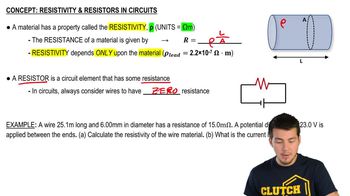
Resistance Calculation

Resistance in an electrical circuit can be calculated using the formula R = V/I, derived from Ohm's Law. It represents how much a device resists the flow of electric current. When the voltage changes, as in the case of using a hair dryer in Europe, recalculating resistance helps understand how the device will behave under different electrical conditions.
Video consigliato:
Percorso guidato
05:25
Resistivity & Resistors in Circuits