
Ch 26: Direct-Current Circuits
Young & Freedman Calc - University Physics 14th Edition
Young & Freedman Calc14th EditionUniversity PhysicsISBN: 9780321973610Non è quello che usi tu?Cambia libro di testo
Capitolo 26, Problema 53

A 1500 W electric heater is plugged into the outlet of a 120 V circuit that has a 20 A circuit breaker. You plug an electric hair dryer into the same outlet. The hair dryer has power settings of 600 W, 900 W, 1200 W, and 1500 W. You start with the hair dryer on the 600 W setting and increase the power setting until the circuit breaker trips. What power setting caused the breaker to trip?

Guida verificata passo dopo passo
1
First, calculate the current drawn by the electric heater using the formula for power: \( P = IV \), where \( P \) is power, \( I \) is current, and \( V \) is voltage. Rearrange the formula to solve for current: \( I = \frac{P}{V} \). Substitute \( P = 1500 \) W and \( V = 120 \) V to find the current drawn by the heater.
Next, determine the maximum allowable current for the circuit before the breaker trips, which is given as 20 A.
Calculate the remaining current capacity available for the hair dryer by subtracting the current drawn by the heater from the maximum allowable current: \( I_{remaining} = 20 \text{ A} - I_{heater} \).
For each power setting of the hair dryer (600 W, 900 W, 1200 W, and 1500 W), calculate the current drawn using the formula \( I = \frac{P}{V} \), where \( V = 120 \) V. Compare each calculated current with the remaining current capacity.
Identify the power setting at which the sum of the currents drawn by the heater and the hair dryer exceeds 20 A, causing the circuit breaker to trip.

Risposta video verificata per un problema simile:

Questa soluzione video è stata consigliata dai nostri tutor come utile per risolvere questo problema.
Durata del video:
3m

Concetti chiave

Ecco i concetti essenziali che devi comprendere per rispondere correttamente alla domanda.

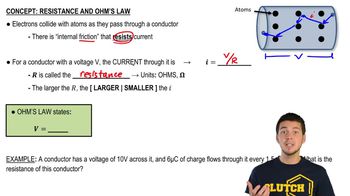
Ohm's Law

Ohm's Law is a fundamental principle in physics that relates voltage (V), current (I), and resistance (R) in an electrical circuit through the equation V = IR. This law helps determine the current flowing through a circuit when the voltage and resistance are known, which is crucial for understanding how much current the heater and hair dryer draw from the circuit.
Video consigliato:
Percorso guidato
03:07
Resistance and Ohm's Law

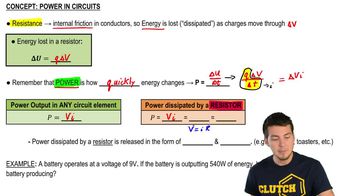
Power in Electrical Circuits

Power in electrical circuits is calculated using the formula P = VI, where P is power in watts, V is voltage in volts, and I is current in amperes. This concept is essential for determining how much power each device (heater and hair dryer) consumes and how it affects the total current drawn from the circuit, which is critical for assessing when the circuit breaker will trip.
Video consigliato:
Percorso guidato
06:18
Power in Circuits

Circuit Breaker Functionality

A circuit breaker is a safety device designed to protect an electrical circuit from damage caused by excess current. It automatically interrupts the current flow when it exceeds a predetermined limit, in this case, 20 A. Understanding how a circuit breaker operates is key to determining the power setting at which the combined current from the heater and hair dryer exceeds this limit, causing the breaker to trip.
Video consigliato:
Percorso guidato
08:30
Intro to Wave Functions