Ch 30: Inductance
Young & Freedman Calc - University Physics 14th Edition
Young & Freedman Calc14th EditionUniversity PhysicsISBN: 9780321973610Non è quello che usi tu?Cambia libro di testo
Capitolo 30, Problema 38b

An L-R-C series circuit has L = 0.600 H and C = 3.00 mF. What value of R gives critical damping?

Guida verificata passo dopo passo
1
Understand that critical damping in an L-R-C circuit occurs when the damping is just enough to prevent oscillations. This happens when the damping coefficient is equal to the natural frequency of the system.
Recall the formula for the damping coefficient \( \gamma \) in an L-R-C circuit, which is given by \( \gamma = \frac{R}{2L} \).
The natural frequency \( \omega_0 \) of the circuit is given by \( \omega_0 = \frac{1}{\sqrt{LC}} \).
For critical damping, set the damping coefficient equal to the natural frequency: \( \frac{R}{2L} = \frac{1}{\sqrt{LC}} \).
Solve for \( R \) by rearranging the equation: \( R = 2L \times \frac{1}{\sqrt{LC}} \). Substitute the given values of \( L = 0.600 \) H and \( C = 3.00 \) mF to find the value of \( R \).

Risposta video verificata per un problema simile:

Questa soluzione video è stata consigliata dai nostri tutor come utile per risolvere questo problema.
Durata del video:
2m

Concetti chiave

Ecco i concetti essenziali che devi comprendere per rispondere correttamente alla domanda.

Critical Damping

Critical damping occurs in a system when the damping is just enough to prevent oscillations. In an L-R-C circuit, it ensures the system returns to equilibrium as quickly as possible without oscillating. It is achieved when the damping coefficient equals the natural frequency of the system, leading to a smooth and rapid return to equilibrium.
Video consigliato:

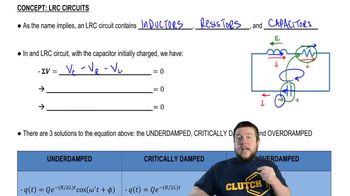
Damping in L-R-C Circuits

Damping in L-R-C circuits refers to the resistance that reduces the amplitude of oscillations over time. It is influenced by the resistor (R) in the circuit. The damping effect can be underdamped, critically damped, or overdamped, depending on the value of R relative to the inductance (L) and capacitance (C). Critical damping is the optimal condition for rapid stabilization.
Video consigliato:

Resonance Frequency

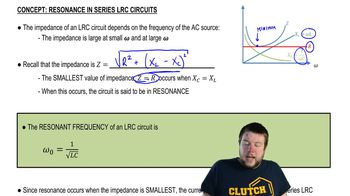
The resonance frequency in an L-R-C circuit is the frequency at which the circuit naturally oscillates when not damped. It is determined by the inductance (L) and capacitance (C) and is given by the formula ω₀ = 1/√(LC). This frequency is crucial for calculating the damping conditions, including critical damping, as it relates to the system's natural response.
Video consigliato:
Percorso guidato
05:23
Resonance in Series LRC Circuits