Ch 33: The Nature and Propagation of Light
Young & Freedman Calc - University Physics 14th Edition
Young & Freedman Calc14th EditionUniversity PhysicsISBN: 9780321973610Non è quello che usi tu?Cambia libro di testo
Capitolo 33, Problema 1

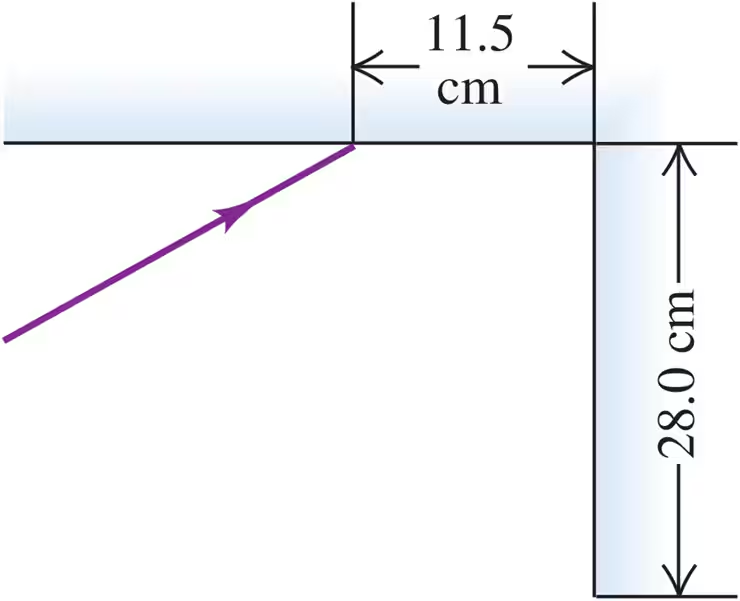
Two plane mirrors intersect at right angles. A laser beam strikes the first of them at a point 11.5 cm from their point of intersection, as shown in Fig. E33.1. For what angle of incidence at the first mirror will this ray strike the midpoint of the second mirror (which is 28.0 cm long) after reflecting from the first mirror?

Guida verificata passo dopo passo
1
Understand the setup: Two plane mirrors intersect at right angles, forming a corner. A laser beam strikes the first mirror at a point 11.5 cm from the intersection.
Identify the goal: We need to find the angle of incidence at the first mirror such that the reflected ray strikes the midpoint of the second mirror, which is 28.0 cm long.
Calculate the position of the midpoint of the second mirror: Since the second mirror is 28.0 cm long, its midpoint is at 14.0 cm from the intersection.
Use the law of reflection: The angle of incidence is equal to the angle of reflection. Set up the geometry of the situation to find the path of the ray from the first mirror to the midpoint of the second mirror.
Apply trigonometry: Use the distances (11.5 cm from the intersection to the point of incidence on the first mirror and 14.0 cm to the midpoint of the second mirror) to form a right triangle. Use trigonometric relationships to solve for the angle of incidence.

Risposta video verificata per un problema simile:

Questa soluzione video è stata consigliata dai nostri tutor come utile per risolvere questo problema.
Durata del video:
4m

Concetti chiave

Ecco i concetti essenziali che devi comprendere per rispondere correttamente alla domanda.

Reflection of Light

Reflection is the change in direction of a wavefront at an interface between two different media so that the wavefront returns into the medium from which it originated. The law of reflection states that the angle of incidence is equal to the angle of reflection, which is crucial for determining the path of the laser beam as it strikes and reflects off the mirrors.
Video consigliato:
Percorso guidato
06:25
Law of Reflection

Geometry of Plane Mirrors

Plane mirrors are flat reflective surfaces that alter the path of light according to the law of reflection. When two plane mirrors intersect at right angles, they create a predictable path for light rays, allowing for calculations of angles and distances. Understanding the geometry of these mirrors helps in determining the trajectory of the laser beam as it reflects between them.
Video consigliato:
Percorso guidato
06:06
Ray Diagrams for Plane Mirrors

Angle of Incidence

The angle of incidence is the angle between the incoming ray and the normal (perpendicular) to the surface at the point of contact. It is a critical factor in determining how the laser beam will reflect off the first mirror and subsequently strike the second mirror. Calculating the correct angle of incidence ensures the beam reaches the desired point on the second mirror.
Video consigliato: