

Ch 33: The Nature and Propagation of Light
Young & Freedman Calc - University Physics 14th Edition
Young & Freedman Calc14th EditionUniversity PhysicsISBN: 9780321973610Non è quello che usi tu?Cambia libro di testo
Capitolo 33, Problema 25

Unpolarized light with intensity I0 is incident on two polarizing filters. The axis of the first filter makes an angle of 60.0° with the vertical, and the axis of the second filter is horizontal. What is the intensity of the light after it has passed through the second filter?

Guida verificata passo dopo passo
1
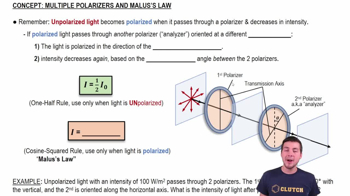
Start by understanding that unpolarized light has an equal intensity in all directions. When it passes through the first polarizing filter, the intensity is reduced by half. Therefore, the intensity after the first filter is I1 = I0 / 2.
Next, apply Malus's Law to determine the intensity of light after it passes through the second polarizing filter. Malus's Law states that the intensity I after passing through a polarizer is given by I = I1 * cos^2(θ), where θ is the angle between the light's polarization direction and the axis of the polarizer.
In this problem, the angle θ between the light's polarization direction after the first filter (which is at 60.0° to the vertical) and the axis of the second filter (which is horizontal) is 90.0° - 60.0° = 30.0°.
Substitute the values into Malus's Law: I = (I0 / 2) * cos^2(30.0°).
Calculate cos(30.0°), which is √3/2, and then square it to find cos^2(30.0°). Substitute this value back into the equation to find the final intensity of the light after it passes through the second filter.

Risposta video verificata per un problema simile:

Questa soluzione video è stata consigliata dai nostri tutor come utile per risolvere questo problema.
Durata del video:
3m

Concetti chiave

Ecco i concetti essenziali che devi comprendere per rispondere correttamente alla domanda.

Unpolarized Light

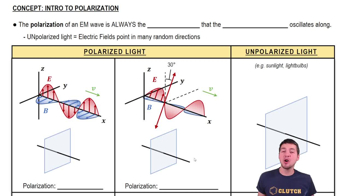
Unpolarized light consists of waves vibrating in multiple planes perpendicular to the direction of propagation. When such light encounters a polarizing filter, it becomes polarized, meaning it vibrates in a single plane. The intensity of unpolarized light is reduced by half after passing through the first polarizer, as only the component aligned with the filter's axis is transmitted.
Video consigliato:
Percorso guidato
10:30
Ray Nature of Light

Malus's Law

Malus's Law describes how the intensity of polarized light changes as it passes through a second polarizing filter. The transmitted intensity I is given by I = I0 * cos²(θ), where I0 is the initial intensity and θ is the angle between the light's polarization direction and the filter's axis. This law is crucial for calculating the intensity after the second filter in the given problem.
Video consigliato:
Percorso guidato
09:47
Multiple Polarizers & Malus's Law

Polarization Angle

The polarization angle is the angle between the polarization direction of light and the axis of a polarizing filter. In the problem, the first filter is at 60° to the vertical, and the second is horizontal, making the effective angle between the polarized light from the first filter and the second filter's axis 30°. This angle is used in Malus's Law to determine the final intensity.
Video consigliato:
Percorso guidato
05:32
Introduction to Polarization
Pratica correlata
Domanda del libro di testo

A beam of light strikes a sheet of glass at an angle of 57.0° with the normal in air. You observe that red light makes an angle of 38.1° with the normal in the glass, while violet light makes a 36.7° angle. What are the speeds of red and violet light in the glass?

389
views
Domanda del libro di testo

It is proposed to store 1.00 kWh = 3.60 × 10⁶ J of electrical energy in a uniform magnetic field with magnitude 0.600 T. If instead this amount of energy is to be stored in a volume (in vacuum) equivalent to a cube 40.0 cm on a side, what magnetic field is required?

2101
views
Domanda del libro di testo

A beam of unpolarized light of intensity I0 passes through a series of ideal polarizing filters with their polarizing axes turned to various angles as shown in Fig. E33.27. If we remove the middle filter, what will be the light intensity at point C?

1707
views
Domanda del libro di testo

The indexes of refraction for violet light (λ = 400 nm) and red light (λ= 700 nm) in diamond are 2.46 and 2.41, respectively. A ray of light traveling through air strikes the diamond surface at an angle of 53.5° to the normal. Calculate the angular separation between these two colors of light in the refracted ray.

1279
views
Domanda del libro di testo

Light of original intensity I0 passes through two ideal polarizing filters having their polarizing axes oriented as shown in Fig. E33.28. You want to adjust the angle f so that the intensity at point P is equal to I0/10. If the original light is linearly polarized in the same direction as the polarizing axis of the first polarizer the light reaches, what should Φ be?

1411
views
Domanda del libro di testo

Light of original intensity I0 passes through two ideal polarizing filters having their polarizing axes oriented as shown in Fig. E33.28. You want to adjust the angle f so that the intensity at point P is equal to I0/10. If the original light is unpolarized, what should Φ be?

1360
views